Showing posts with label mistakes. Show all posts

Sunday, 16 September 2012

Learning Korean... How to study korean, how to improve your Korean 5

In the last couple of posts I talked about books and strategies that can help you improve your Korean on your own. Here is a summary of the resources I use, and some other tips too.

Reference Resources:

  • Korean Grammar for international Learners (yonsei university)
  • An English Korean dictionary (the longer the entries the better)

Books which help (click on the links for details):

General tips for language learning

  • Confidence. Always be confident
  • An open mind. Nothing is fixed in language and there are countless exceptions. Don't remember the rules, remember what breaks the rules
  • Learn from mistakes. Everyone makes mistakes, what you need to do is learn from them. Don't worry if you make a mistake! Worry if you keep on making it
  • Awareness. Always be aware of what you and others are saying. every time you hear or say something strange make a mental note of it. You will learn a lot like this.
  • Take every opportunity. Every oppportunity there is to speak or practise, use it. That means speaking to anyone, doing homework, answering questions in class. Whenever you can speak or write or read Korean do it.
  • Make friends with native speakers. Not only do you really experience the culture and language through them they can act as dictionaries and teachers. Without them, you will never learn Korean properly
  • Don't obsess about grammar Grammar is not language, it is a system for understanding language. In itself its pointless so forget about it when it's too hard.
  • Enjoy it! Find something you love about the language and focus on that. You and your mind will change for ever (and for the better!)

And finally

Textbooks, workbooks, exercise books and grammar books are totally and utterly useless except when attending a class. Never waste your money on these if you're not going to go to a class which requires them.

Learning Korean... How to study korean, how to improve your Korean 4

I wrote about the little yellow book 한국문화 77hanguk munhwa 77 and how it gets much easier the more you read it. I was getting towards the end and I decided I wanted to try and expose myself to some "real" Korean. This means not Korean written for foreigners, but Korean written for Koreans.


I had a few spare minutes in a train station, so I checked out the kids section in the bookshop. I was looking for something with lots of pictures but also a good amount of text. And as luck would have it, I found a book of folktales aimed at first year elementary kids. It had everything I wanted. I could understand all the grammar, I just needed to check up on some of the vocabulary and I could read it before bed!

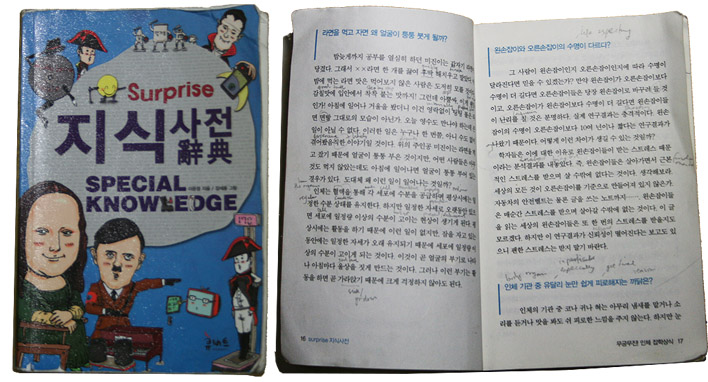
When I finished 한국문화 77hanguk munhwa 77 I wanted something a little more "relevant" to modern life, and a little more mature than a fairytale book. Luckily my friend had recently bought this little gemhe got it at emart:

At the beginning this book was hard, especially in terms of vocabulary... but as with the everything, the more you do it, the easier it becomes. This book is the best for learning Korean I have encountered because:

  • it has short texts (about 200 words in length)
  • The contents are really interesting: little facts and myths about science, history, modern life, culture
  • Everything is arranged by chapters: science, history, medicine etc. so if you read one little passage after the other, the same vocabulary is repeated, and they become progressively easier to understand and require less dictionary work
  • it's aimed at young adults (ie me) so the language is not archaic, childish or wildly complicated and technical
  • It's written for Koreans so the Korean is natural and unedited.
  • It's small so you can take it wherever you go - notice the wear and tear. I spend a lot of time in the subway so I read it there, adding up to about 60-80 minuted of reading 3 times a week!

Since this book is aimed at Koreans, it can be a little challenging at points, I started reading it also about 6 or 7 months in, but now after 9 months I can read about 3 passages in less than 40 minutes! I would recommend that if you really can't understand the first text (using a dictionary of course) to put it down, and try again a little later.

Saturday, 8 September 2012

Learning Korean... How to study korean, how to improve your Korean 3

In the last two posts I wrote a short guide on how to use a few materials to help you improve your Korean. These are the beginner levels. Once you've studied Korean for 3-4 months, it's time to upgrade.

By this stage you should be able to:

  • Read basic Korean texts
  • Have conversations about the weather, the future, your favourite films etc.
  • Talk to people in casual environments: restaurants, bars
  • Understand whole sentences or dialogues in films and songs
  • Ask for and understand directions
  • Make long sentences using different endings like -지만jiman, -는데-neun-dae, -니-ni etc. etc.

If you can do these things, that's fantastic! But it means the first stage is over and you have to work even harder and you now have no excuse not to speak Korean all the time! For study alone time I recommend this book:

I started reading it about 3-4 months into the course and at the beginning it was difficult. I persevered, reading it in the subway every day and using my little phone dictionary, writing the new vocab in pencil next to the new words. By the end it was so easy I could read one of the little texts in about 5 minutes! The satisfaction is amazing.

It's aimed at TOPIK students who want level 3 and each page has a little cartoon and Korean story about Korean culture. It's really fun, informative and best of all each little text is short enough for it not to be boring. You can buy it in any big bookshop.

Learning Korean... How to study korean, how to improve your Korean 2

In this post I wrote some tips for beginners of Korean. This next post is for people who have studied for 2-3 months.

At this stage you should be able to:

  • identify words and short phrases in songs, conversation, films etc.
  • make short sentences about today, tomorrow and yesterday
  • read and write short sentences and even paragraphs
  • Talk to Koreans on a very basic level (ordering food or saying hello etc.)

As you can see I've gone from a kindergarten book that focuses on writing only letters to elementary level 1. The first book (국어 읽기 1-1gook-eo ilk-ki 1-1 / Korean reading 1-1) is much easier than the second (국어 읽기 1-2gook-eo ilk-ki 1-2 / Korean reading 1-2), but there are lots of great stories with pictures. I have to admit, even after 2 months I couldn't understand very much of it, but it was good to encounter some real Korean. Just keep trying and you'll be amazed when suddenly it becomes easy!

Also there's a grammar reference book. This can be very helpful or totally useless depending on how you use it. This is a reference book. Use it when you come across a grammatical ending you don't understand and look it up in this book. Do not use it to learn new grammar, do not use it as a text book and read it from beginning to end. You will just get confused and learn nothing. There's a long explanation for why this is, so if you want to get in touch and I will explain it.

Monday, 27 August 2012

Learning Korean... How to study korean, how to improve your Korean

For many people, learning Korean is an uphill struggle. Like climbing an endless, endlessly steep slope with no end. You have to take things in your stride, be realistic about where you want to reach and where you are in realtion to your final goal.

The most important thing is ATTITUDE. Never ever go into class, a conversation or a newspaper article thinking "I can't do this" "this is too difficult". Unfortunately Koreans have this attitude to language learning and it easily rubs off on you. Brush it off! But you also have to be realistic - focus on what you know and then if you learn something new, be proud of yourself. That is learning! If you don't know something, forget it. What you know is more much more important.

Once you have the right ATTITUDE, you need the right TOOLS. These will change and develop, as you improve. When you are a beginner, what you need is a phrasebook, a dictionary and a kids book.

Use the kids book to practise the alphabet and keep you entertained with pretty pictures. It will naturally teach you some words while you practise, although these may well be animals. Just remember, in the long run, everything, and I mean everything helps.
Use the phrasebook to learn practical words, expressions and phrases without getting confused by boring and irrelevant grammatical explanations. This will help you start talking immediately. Don't worry if you don't undersand anyone though. Focus on understanding individual words that you already know.
Use the dictionary whenever you can. An electronic one will help. If you see a sign, look up the words. If you hear a word often, try and guess how to spell it, and look it up. Use it to check words you have forgotten, BUT never, ever, ever look up a word in English and translate it into Korean. This is a terrible, terrible idea because no one will understand you and you will be confused and lose confidence. Trust me.

The kids book is for kindergarten children and literally teaches you how to write. Simple and great. The "teach yourself Korean" is a great book with dialogues and phrases and even simple grammatical explanations. It's only disadvantage and this is a big one, is that everything is transliterated into English letters. Ie, no Korean characters. And finally I still use the phone as a dictionary today. The dictionary is extremely in depth.

Friday, 30 March 2012

Why are Koreans so pedantic?

One of the mainstays of the Korean course so far has been the "dreaded" 받아쓰기badasseugi, better known as a dictation in English. We get dictated 10 sentences at random speeds which we have to write down. These sentences all come from the textbook, either from the selection of example sentences or from the dialogues. So the most studious of students just memorise the lot. According to the teacher, the purpose of this test is to improve writing and spelling.

The total score is out of 10 and even the smallest mistake means the whole sentence is wrong. This is something which has always baffled me. Because of the time constraints and speed writing a learner of a foreign language is naturally going to make silly mistakes ie: -먄-myan instead of -면-myeon. I know how to spell that, I just was in an unnatural situation and lost concentration! Yet they never take this into account.

Yesterday though there was a small mark on the paper, which appeared to change 니까-nikka to 나까-nakka / looks worse in English doesn't it?. An equally silly mistake, however the fact is that with a little bit of inspection it was obvious that this was just a mark. The teacher was looking so hard for mistakes, that even when they weren't there she found them. By focusing on this kind of error it shows that she is expecting students to make mistakes, whatever the reason! If they were actually testing spelling, then surely they should focus on difficult to spell words like the cursed "괜찮아"gwaenchana / it's ok instead?

As a teacher doing this kind of task, I would take away marks accordingly, accounting for the different kind of mistakes. But in Korea wrong is wrong, no discussion, justification and to the Westerner it seems just overly pedantic.

But in a way, they do have a point, even the silliest and smallest errors can cause confusion, at the very least! But why be so intolerant in such a controlled environment? Why the lack of task focusing?

I can think of a few reasons:

  • Historical: When Koreans wrote in Chinese characters, even the smallest mistake can totally change the meaning of a whole word, not like a spelling mistake which often just looks weird. This tradition of learning and teaching has been inherited by modern Korean.
  • Linguistic: Korean, in it's nature is very "pedantic" There are literally thousands and thousands of words which have extremely specific meanings. You don't know that word and you can't say the phrase. Same with the endings that they use. There are many different endings which have extremely specific, one off, meanings: You use it wrong and you can insult someone. So be careful from the beginning.
  • Cultural: Mistakes are seen differently here. People will go to extreme lengths to avoid making a mistake, to the extent that they will actually remain silent when they don't know the answer to a question. Extremely rude in Western culture, totally normal here.

Perhaps then, by our standards, Koreans are "pedantic" when it comes to tests, but this is clearly just a cultural perspective. They find it equally difficult and confusing when an English native-speaker is completely "tolerant" of even the smallest mistakes they make! Finally a lasting testament to Korean accuracy can be seen in the Tripitaka Koreana, a collection of Buddhist texts written in Hanja: 52,382,960 chinese characters and not one error!