Showing posts with label learning language. Show all posts

Tuesday, 16 October 2012

Useful Korean phrases: (으)나 마나

In Korea people are very considerate so when you're meeting Korean friends it can take a long time to decide where to go and what to do, because they don't want to offend you. Of course you don't want to offend them but you don't know about Korea as much as they do so a very useful phrase to say is "it doesn't matter" or "it makes no difference" "it's the same" and even "I don't mind" if they suggest something.

In Korean it's the form -(으)나 마나-eu-na mana And it attaches to the stem of the verb like this 먹다meog-da -> 먹으나 마나meog-eu-na mana or 보다bo-da -> 보나 마나bo-na ma-na. You can either finish the sentence with this form by adding -요-yoor say make a little comment after it (look at the examples below):

When you want to use this, just practise answering a suggestion like "let's go to the bank first?" or "is it ok if we go to the bank first?". Then when you're comfortable with the meaning, you can try making longer sentences

As a final note the ending -나-na actually means "or". The verb 말다malda means "to not do", so a more literal translation could be "either if we do something or don't it it's the same".

Sunday, 16 September 2012

Learning Korean... How to study korean, how to improve your Korean 5

In the last couple of posts I talked about books and strategies that can help you improve your Korean on your own. Here is a summary of the resources I use, and some other tips too.

Reference Resources:

  • Korean Grammar for international Learners (yonsei university)
  • An English Korean dictionary (the longer the entries the better)

Books which help (click on the links for details):

General tips for language learning

  • Confidence. Always be confident
  • An open mind. Nothing is fixed in language and there are countless exceptions. Don't remember the rules, remember what breaks the rules
  • Learn from mistakes. Everyone makes mistakes, what you need to do is learn from them. Don't worry if you make a mistake! Worry if you keep on making it
  • Awareness. Always be aware of what you and others are saying. every time you hear or say something strange make a mental note of it. You will learn a lot like this.
  • Take every opportunity. Every oppportunity there is to speak or practise, use it. That means speaking to anyone, doing homework, answering questions in class. Whenever you can speak or write or read Korean do it.
  • Make friends with native speakers. Not only do you really experience the culture and language through them they can act as dictionaries and teachers. Without them, you will never learn Korean properly
  • Don't obsess about grammar Grammar is not language, it is a system for understanding language. In itself its pointless so forget about it when it's too hard.
  • Enjoy it! Find something you love about the language and focus on that. You and your mind will change for ever (and for the better!)

And finally

Textbooks, workbooks, exercise books and grammar books are totally and utterly useless except when attending a class. Never waste your money on these if you're not going to go to a class which requires them.

Learning Korean... How to study korean, how to improve your Korean 4

I wrote about the little yellow book 한국문화 77hanguk munhwa 77 and how it gets much easier the more you read it. I was getting towards the end and I decided I wanted to try and expose myself to some "real" Korean. This means not Korean written for foreigners, but Korean written for Koreans.


I had a few spare minutes in a train station, so I checked out the kids section in the bookshop. I was looking for something with lots of pictures but also a good amount of text. And as luck would have it, I found a book of folktales aimed at first year elementary kids. It had everything I wanted. I could understand all the grammar, I just needed to check up on some of the vocabulary and I could read it before bed!

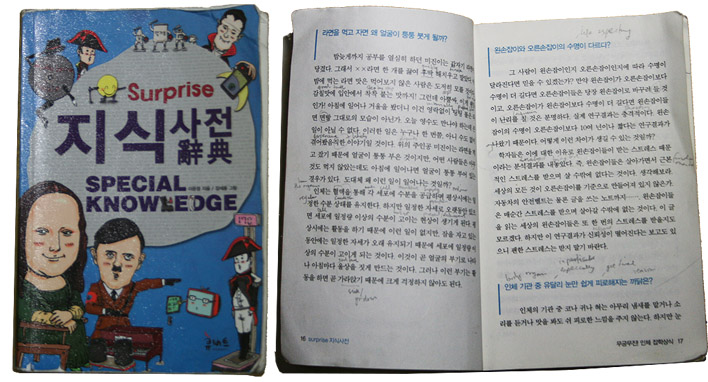
When I finished 한국문화 77hanguk munhwa 77 I wanted something a little more "relevant" to modern life, and a little more mature than a fairytale book. Luckily my friend had recently bought this little gemhe got it at emart:

At the beginning this book was hard, especially in terms of vocabulary... but as with the everything, the more you do it, the easier it becomes. This book is the best for learning Korean I have encountered because:

  • it has short texts (about 200 words in length)
  • The contents are really interesting: little facts and myths about science, history, modern life, culture
  • Everything is arranged by chapters: science, history, medicine etc. so if you read one little passage after the other, the same vocabulary is repeated, and they become progressively easier to understand and require less dictionary work
  • it's aimed at young adults (ie me) so the language is not archaic, childish or wildly complicated and technical
  • It's written for Koreans so the Korean is natural and unedited.
  • It's small so you can take it wherever you go - notice the wear and tear. I spend a lot of time in the subway so I read it there, adding up to about 60-80 minuted of reading 3 times a week!

Since this book is aimed at Koreans, it can be a little challenging at points, I started reading it also about 6 or 7 months in, but now after 9 months I can read about 3 passages in less than 40 minutes! I would recommend that if you really can't understand the first text (using a dictionary of course) to put it down, and try again a little later.

Saturday, 8 September 2012

Learning Korean... How to study korean, how to improve your Korean 3

In the last two posts I wrote a short guide on how to use a few materials to help you improve your Korean. These are the beginner levels. Once you've studied Korean for 3-4 months, it's time to upgrade.

By this stage you should be able to:

  • Read basic Korean texts
  • Have conversations about the weather, the future, your favourite films etc.
  • Talk to people in casual environments: restaurants, bars
  • Understand whole sentences or dialogues in films and songs
  • Ask for and understand directions
  • Make long sentences using different endings like -지만jiman, -는데-neun-dae, -니-ni etc. etc.

If you can do these things, that's fantastic! But it means the first stage is over and you have to work even harder and you now have no excuse not to speak Korean all the time! For study alone time I recommend this book:

I started reading it about 3-4 months into the course and at the beginning it was difficult. I persevered, reading it in the subway every day and using my little phone dictionary, writing the new vocab in pencil next to the new words. By the end it was so easy I could read one of the little texts in about 5 minutes! The satisfaction is amazing.

It's aimed at TOPIK students who want level 3 and each page has a little cartoon and Korean story about Korean culture. It's really fun, informative and best of all each little text is short enough for it not to be boring. You can buy it in any big bookshop.

Learning Korean... How to study korean, how to improve your Korean 2

In this post I wrote some tips for beginners of Korean. This next post is for people who have studied for 2-3 months.

At this stage you should be able to:

  • identify words and short phrases in songs, conversation, films etc.
  • make short sentences about today, tomorrow and yesterday
  • read and write short sentences and even paragraphs
  • Talk to Koreans on a very basic level (ordering food or saying hello etc.)

As you can see I've gone from a kindergarten book that focuses on writing only letters to elementary level 1. The first book (국어 읽기 1-1gook-eo ilk-ki 1-1 / Korean reading 1-1) is much easier than the second (국어 읽기 1-2gook-eo ilk-ki 1-2 / Korean reading 1-2), but there are lots of great stories with pictures. I have to admit, even after 2 months I couldn't understand very much of it, but it was good to encounter some real Korean. Just keep trying and you'll be amazed when suddenly it becomes easy!

Also there's a grammar reference book. This can be very helpful or totally useless depending on how you use it. This is a reference book. Use it when you come across a grammatical ending you don't understand and look it up in this book. Do not use it to learn new grammar, do not use it as a text book and read it from beginning to end. You will just get confused and learn nothing. There's a long explanation for why this is, so if you want to get in touch and I will explain it.

Monday, 27 August 2012

Learning Korean... How to study korean, how to improve your Korean

For many people, learning Korean is an uphill struggle. Like climbing an endless, endlessly steep slope with no end. You have to take things in your stride, be realistic about where you want to reach and where you are in realtion to your final goal.

The most important thing is ATTITUDE. Never ever go into class, a conversation or a newspaper article thinking "I can't do this" "this is too difficult". Unfortunately Koreans have this attitude to language learning and it easily rubs off on you. Brush it off! But you also have to be realistic - focus on what you know and then if you learn something new, be proud of yourself. That is learning! If you don't know something, forget it. What you know is more much more important.

Once you have the right ATTITUDE, you need the right TOOLS. These will change and develop, as you improve. When you are a beginner, what you need is a phrasebook, a dictionary and a kids book.

Use the kids book to practise the alphabet and keep you entertained with pretty pictures. It will naturally teach you some words while you practise, although these may well be animals. Just remember, in the long run, everything, and I mean everything helps.
Use the phrasebook to learn practical words, expressions and phrases without getting confused by boring and irrelevant grammatical explanations. This will help you start talking immediately. Don't worry if you don't undersand anyone though. Focus on understanding individual words that you already know.
Use the dictionary whenever you can. An electronic one will help. If you see a sign, look up the words. If you hear a word often, try and guess how to spell it, and look it up. Use it to check words you have forgotten, BUT never, ever, ever look up a word in English and translate it into Korean. This is a terrible, terrible idea because no one will understand you and you will be confused and lose confidence. Trust me.

The kids book is for kindergarten children and literally teaches you how to write. Simple and great. The "teach yourself Korean" is a great book with dialogues and phrases and even simple grammatical explanations. It's only disadvantage and this is a big one, is that everything is transliterated into English letters. Ie, no Korean characters. And finally I still use the phone as a dictionary today. The dictionary is extremely in depth.

Thursday, 23 August 2012

맞다 - get hit/struck/pricked

One of the biggest failures of the course that I am taking is that they abjectly refuse to teach any patterns. Every single word is seen as different and therefore, even though it's THE SAME word, they make you believe it has only one specific meaning and one specific use.
This is because Koreans hate it when anyone makes a mistake. When you start to learn a pattern, you are bound to make mistakes, so better not teach a pattern. This IMPEDES the language learning process. You learn by MAKING mistakes. You learn by speaking and creating. This method of teaching WITHHOLDS the tools which enable you to create and therefore speak.

rant over

The verb 맞다mat-da does actually have many distinct meanings, but one group is definitely the same. In many cases it means "get hit/struck/pricked". So here are some useful expressions all with 맞다mat-da meaning the SAME thing.

notice how the thing that hits you is the object, so in a way 맞다mat-da can be very generally translated as "get"

rant continues

They only taught me 주사(를) 맞다ju-sa(reul) mat-da so that was the only one I could say. Three months later, I suddenly realise "ohhhh it's not just for injections" if they had taught me this 3 months ago, I could have said all these three months ago. No wonder no one ever learns anything in class.

Wednesday, 15 August 2012

The reasons Why Korean has so many words 4: Social Reasons Again

Last time I discussed how Korean society used to be caste dominated and how each caste had their own "language" which became part of modern Korean with the arrival of democracy. But even with democracy, Korean society and language continued to be layered.

That's right, it's still layered by age. So you still need all the polite and respectful duplicate words to talk to older people. And older people need to use all the duplicate words to talk down to younger people. Not to mention all the words they use to talk amongst themselves!

Old people, who do not have so much contact with popular culture, use old words for things which young people would use English words for nowadays. Young and old people alike will use special words and phrases, on purpose, in order to show their age and status. And this is another reason why Korean has so many words.

If you want to talk to older or more important people than you, here are the most common polite forms (honorific or humilific) of normal words:

Tuesday, 14 August 2012

The reasons Why Korean has so many words 3: Social Reasons

Last time I discussed how many, many Korean words come from other cultures. However, many many Korean words are also a product of Korean culture and social history too.

Much like India, Korea had a caste system. As a cultural-Brit, I always assumed a caste-system was much like a class-system. Basically, top, middle bottom. What a European way of thinking! Caste-systems are far more complicated than this. You have upper and lower and middle castes, but each caste is more of a represtantion of your specific role in society, not a designation of wealth.
Your job or rather your father's job decided your caste. Basically manual labourers were in the bottom layers of society, but each different job was considered higher or lower than the next. People never intermarried even at those levels. It wasn't just princesses and paupers who couldn't see each other. It was carpenters and masons who couldn't get married. These strict, clear distinctions created a very distinctly layered society.

This solid layering created a society where the only caste mixing took place when trading or doing business. Each caste would have spoken their own language to same-caste-members. There wasn't just "one Korean". But, there wasn't simply a "common language" either. When communicating with higher or lower caste members, people used language specifically designed to talk up or down to people. Just look at all the different speech levels in use today.

So historically, the Korean language had many different branches spoken by many different people. When Korea became a democracy in the 1990s, the caste-layers were blended into one new society. As social barriers broke down, suddenly, all the language and words which were only used by one caste became part of a much larger language which is modern Korean today, growing and multiplying the number of words.

Footnote 1: I am talking about official Korean here, the Korean which is taught to foreigners. There are still many different kinds of Korean.

Footnote 2: Just because the caste system was abolished by no means does this mean the wealth was redistrubted. Generally 양반yang-ban / the top or warrior and scholar caste still have all the money, they just don't wear the hats any more!

Monday, 13 August 2012

The reasons Why Korean has so many words 2: English & 한자 (hanja) the hidden terror behind Korean words

Last time we saw that the very nature of Korean is to have many words because Korean doesn't really use patterns to create meaning. As a result of this, Korean is extremely open to new words from other languages.

Anyone who is familiar with Korea has been baffled, amused, concerned and surprised by the huge amount of English words that have come to Korean and are in every day use. With America as the only superpower and political antithesis to China, Koreans have embraced many aspects of their culture and language.

But long ago, when the world was a different place, Koreans were doing the same thingno surprise here with language. Back then China was the political and cultural centre of Asia. So naturally Korean is full of Chinese too (I've heard about 50% of the words). Before Korean had an alphabet and even after Korean had an alphabet, everything was written in Chinese characters. In a similar way like Latin influencing European languages Chinese did the same thing.

Originally these words came to the language through scholars, traders and politicians (the educated and therefore high classes). So more often than not there is a "pure" Korean equivalent to a word of Chinese origin, which the lower classes would have in common use, resulting in two words with the same meaning.

Even nowadays suffering Korean children are made to memorise countless Chinese characters which form the backbone of so many words. But there is a logic to this, much like English becomes Koreanised So have these characters and Koreans use them as building blocks for making new words which have no Chinese equivalent.

Korean needs words to create meaning. So by absorbing and adapting foreign words they can satisfy that need, often resulting often in duplicate and triplicate synonyms.

Tomorrow one more reason why Korean has so many words!

Sunday, 12 August 2012

The reasons Why Korean has so many words 1

As a student of Korean you can go pretty crazy with the sheer number of synonyms a word can have, and you should learn them all! I first came across this when I started learning family members. For example there are more than three words for wife: 부인, 아내, 집사람bu-in, an-e, jip-sa-ram or child: 자식, 아이(애), 어린이ja-shik, a-i(e), eo-ri-ni. And these are just ones I've heard in conversation or come across in class!

It doesn't stop with nouns or even people, sometimes it seems like there are at least three words for everything in Korean. And by three words, I mean three words that are used every day. Know any other words for children in English? How about progeny or offspring? These are words used in horror films or dusty tomes. (look! another word for book!).

So why is that there are so many more words in use in Korean?

The underlying reason for this is the nature of Korean. Korean words do not change according to their role in the sentence.
In fact the only words which change at all are verbs, and they only change a little. Compare that to English with over 100 irregular verbs. And then bear in mind there are also irregular nouns in English - what's the plural of man, woman, child, person? Or how about adjectives? big - bigger, good - better. This does not happen at all in Korean.

However the point that I am making is not that there are exceptions in English. The point is that there are patterns in English. Korean has very few patterns. So instead of meaning coming from patterns, meaning comes from words and particles

자식ja-shik means something more like "my child(ren)" so you wouldn't use it for some children you saw on the street. In English we just attach "my" to show this relationship or "some" to show that there is no relatiosnhip. Words like "my" "some" or "any" can be attached to any noun and always mean the same thing. ie They follow a pattern. Korean doesn't have this pattern, so in every case of "my" you need a new word.

On the other hand 어린이eo-ri-ni is more of an official word for child. So you see childcare centres called "어린이 집"eo-ri-ni jip / children's house or "children's" tickets as opposed to "adults". So often 어린이eo-ri-ni has a plural sense to it. In English we would just change child to children.

So where English uses an established pattern to change the meaning of a word, Korean instead uses a specific word for each different situation. And that's one reason why Korean has so many words!

In the next post. More reasons why Korean has so many words.

Saturday, 30 June 2012

Korean Basics: making a sentence

Maybe you can remember back to school days, or you’re an English teacher yourself? A sentence in English always needs at least 2 things, and normally more. But the two main things are:

  • a subject – they, she, it, the cat, a bird, my evil twinetc. etc.
  • a verb – eat(s) / swim(s) / run(s) / murdered etc. etc. (a doing word)

So “yes!” is not a sentence and “hungry” is not a sentence either, although you can kind of get what they mean. But what happens if you say “love”? Can you understand the meaning? Who do you love? Who loves you? Do you hate love? Is love great? can your evil twin love? It’s confusing, and it definitely is not a sentence.

In the last basics post I talked about verb endings and politeness. When we use them, it means that we are talking to someone. In English, it's the oppposite, our sentences show that someone is talking, that's why we always need a subject. Without a subject it's difficult to guess who is talking (see above).

Love in Korean is 사랑하다sarang-hada. This is the base form (remember) So when we put an ending on it means that there must be someone you're talking to because you are either showing, or not showing respect.
So imagine your mum is in front of you and you say 사랑해요sarang-hae-yo. In English this literally translates as "love" But of course, if your mum's in front of you, a better translation would be "I love you".

Korean, unlike English, does not need a subject, and often it does not need an object either (what comes after a verb, not before, like the "you" in "I love you"). You can work it out from the situation. So any verb with an ending on it, is in fact a sentence in Korean. So take any verb and put an ending on it! Congratulations! You're speaking Korean in full sentences

But of course sometimes you need to put these words in. Imagine there are three girls/boys in front of you. You want to tell one you love them. If you just say 사랑해요sarang-hae-yo they'll all think you love them!

Monday, 9 April 2012

REPEAT!!!

Some days this is really how I feel they teach us, and this is how they the way we learn. The only way is to constantly, repetitively and ceaselessly chip away at the mind with example sentences. No context, no variety, no interest, and as long as you can write an example sentence, you "know" it.

This is a sketch I did while both my teachers failed extremely successfully at explaining a semantically complex ending. "Look the students don't understand! Lets give them 3 hours of explanation and then command them to make example sentences off the top of their heads. Then give more explanations and then make them create more example sentences. It doesn't work? Let's do the same thing tomorrow and again and again until they just say 'yes we understand' to make us stop."

Guess how many students actually tried making example sentences? 2 out of 14. So 2 out of 14 actually did something. The rest? Silence. And because there was no context it was just a mad guessing game anyway.

Some days I just want a refund

Monday, 2 April 2012

English이란 어려워요!!!!

For a language that has so many words which change depending on speaker and person being spoken to, it's odd that the verbs to borrow and to lend are the same: 빌리다billida. How then do they distinguish them? The answer's quite easy, they use the verb 주다juda / give:

In English, "give" is a very uninteresting verb, but In Korean it has a grammatical function too. It essentially gives the idea that the subject of the verb is doing someone else a favour.

This is one reason why Koreans often struggle with the difference between to/for. They learn that "to" and "for" are both -에/-에게-ae/-aegae. But for once it's English that has a specific meaning. The preposition "for" in itself implies a favour, whereas the ending -에/-에게-ae/-aegae" just means "not the subject or object".

Many learners of Korean (are encouraged to) complain that Korean is difficult, but for once there isn't a specific verb for a specific situation! English is the difficult language. In fact, are there any European languages that use a totally different item of vocabulary? I can't think of any at the moment.


English이란 어려워요!oer-yeo-weo-yo / is difficult

Friday, 30 March 2012

...the dog ate my homework and other excuses

So today I’m missing the first class and I’m going to use various excuses, but there is one reason in particular. Every so often we spend the first lesson of the day practising rote-learned dialogues from the textbook.

I am going to stay as culturally neutral as possible, but this is a total waste of time. I waste more than 30 minutes memorising it of my free time, I waste 2 minutes in class reciting it, and then I waste the next 48 minutes of class listening to other people saying the same thing over and over again. This is a totally outmoded and anachronistic learning method.

Lets go back 2000 years to the time of the great Roman poets, when there were no computers, there were no books and there was very little paper. In these times, the only way to remember large quantities of new vocabulary was to put them into your head, by literally learning books off by heart. Instead of referring to a page in your notebook, you could go into your memory and find the right lines etc, or even more likely, be reminded of the word when you hear it.

When you were a child do you remember misunderstanding songs, and only realising what the words meant later in life, but you could sing the song perfectly anyway? Learning things off by heart does not help you to use and understand new vocabulary. It helps you to recite the things that you have learned off by heart. Anyone can learn any group of sounds together, you don’t need to know what they mean in order to do this.

This teaching method is totally irrelevant to modern day life, is highly inefficient and ultimately pretty much useless. It restricts you to only the learned conversations, it makes you unable to put your own sentences together and it destroys your confidence in the language. By learning like this you will never understand anyone because people don’t speak the exact same dialogues as in the textbook.

그래서 선생님, 내가 결석 했다geureseo, seonsengnim, naega gyeolseok haedda / check google translate to see what that means

Slow Days

These past few days have been relatively slow. I am beginning to think that the Korean attitude to language is that it just as a set of unrelated phenomena that all have equal weight and value, and can only be learned individually. Don’t take my tone as critical or negative, it’s probably because I am sick!

The “grammar” points have basically been extensions of meaning in already learned forms. We have already studied the -지 않다-ji anta form which basically negates a verb, and we just recycled it as a question: 예쁘지 않아요?yeppeuji anayo? / she isn’t pretty? as opposed to 예쁘지 않아요yeppeuji anayo / she isn’t pretty. This seems to me to be totally logical and everyone has already been asking questions like this anyway, because it’s easier than inserting other question endings/particles.

Same with -는데-neunde, we recycled it again as -는데요neunde-yo. I shouldn’t complain because we got to practise this extremely flexible and useful ending which I still don’t understand fully. We just learned it as an ending to a sentence rather than as some kind of conjunction. Although I’m not sure what the difference is exactly, it probably is something like: “I don’t like strawberries though”. As opposed to “I don’t like strawberries, though I’m hungry.”

I suppose this kind of thoroughness helps students unfamiliar with grammatical forms and it might also help those who need the writing practice, but couldn’t we just learn something new instead… There’s so much I still have no clue about!

Just one of the reasons why I love learning Korean

It’s a bit long, but keep reading, and you might understand why I chose the title. By studying Korean at a university, I’m not just learning a set of words or a grammatical code by which to interpret them and I’m not just learning about Korean culture and my culture. I am also learning about how Koreans see their own language and culture and by extension all language and all culture.

Unsurprisingly the Korean text book is divided into the same sections in every chapter, one of which deals with grammar and another vocabulary. Today’s grammar was about turning verbs into nouns and using them as the subject of a sentence: “Swimming is difficult” as opposed to “I swim with difficulty”. This can be done in different ways in Korean, but today we dropped the -다-da and added -기-gi to the stem: 수영하다 > 수영하기suyonghada > suyonghagi / to swim > swimming. Then to make it clear it’s the subject added the subject particle -가ga. 수영하-기-가 어려워요suyongha-gi-ga oer-yeoweo-yo

In fact we had already learned this -기-gi form in the context of 때문에ddaemunae / because of . So 수영하기 때문에 피곤해요suyonghagi ddemunae pigonheyo becomes because of swimming I am tired (not great English, but you understand it!). Now as a student of European languages and culture, it seems obvious that 수영하기suyeonghagi / to swim can be used anywhere in a sentence where you would use a noun. As the subject, object, indirect object, following a preposition etc. etc. So I was a little confused.

Why teach it as the subject only. Can this -기-gi form only be used as the subject? My European brain was instantly applying some kind of order or grammitcal pattern to this and I began to question the the whole schema, why would they teach us this in only one case when you can learn all of them at once? (see how latin is taught for reference). So I asked the teacher “can -기-gi nouns only be the subject?”

Can you guess her answer? If you’re Korean you probably can, if you’re European, you probably can’t!

She told me “this(어렵다oer-yeopda / to be difficult) is an intransitive (descriptive) verb (ie, it takes only a subject eg. sleep), so it can only be the subject”. ARRRGHHH!!! She didn’t answer the question. She saw my problem in terms of only the example sentence. My question on the other hand dealt with rules and grammar, and not the example sentence.

This experience highlights the day-to-day communication breakdowns that occur when West meets East. In the context of language learning it specifically demonstrates how Eastern and Western views of language differ. Essentially for a Korean 수영하기suyonghagi / swimmingas subject, object etc. etc. is a different 수영하기suyonghagi / swimmingevery time. Where for the European it’s always a “gerund” (or whatever name we choose to give it). With these parallel views, everything must seem different, depending on the language you speak and the culture you grew up in. And that’s why I chose the title!