Showing posts with label culture. Show all posts

Friday, 28 September 2012

The reason why Koreans are born at 1 year old

The last two posts were about the complicated way in which people count age and birthdays in Korea, but did you ever stop and wonder why Koreans are born at 1 year old? If you ask anyone who's been in Korea a while, the answer you will doubtlessly hear is that the 9 months the baby spends in the womb counts as 1 year. If you don't think about it, it seems to make sense, but give it a moment's thought and really is just total nonsense. Firstly How can 9 months be counted as a year? And if you don't know when the child was conceived, how on Earth can you start counting it's age?
The real reason is mainly mathematical, but has a lot to do with Korean culture too.

Korean culture is extremely conservative. Ancient practises, customs and habits have been fossilised into the fabric of modern korean society and they still shape attitudes today. For example In the 17th century some European sailors shipwrecked on the shore of Jeju-do were arrested and held captive in Korea for 13 years basically because they were foreigners. Not much has changed: just think about your friends with Korean wives! hahaha... Anyway Because Korean culture is so conservative many things which other cultures have forgotten about are kept alive. And one of these things is inclusive counting.

Before the invention and importation of zero to Europe and East Asia, inclusive counting was the standard. Remember Roman numerals? There's no zero there. When zero arrived a new counting system was invented and inclusive counting was forgotten, in most places, for ever.

Inclusive counting basically means that instead of counting from 0, you start counting from 1. And when people counted days, months, years, they used this system.

Today is Saturday.
Not counting inclusively, if I say "in two days" I mean Monday. Saturday is "0", Sunday "1" and Monday "2".
Counting inclusively Saturday is "1" Sunday is "2" and Monday is "3".
So that means if I wanted to say "in 2 days (on Monday)" using inclusive counting I would have had to say "in 3 days"!

It's exactly the same with years and if we count backwards.
It's 2012
Not counting inclusively if I say "three" years ago I mean 2009 -> 2012 is "0" 2011 is "1" 2010 is "2" and 2009 is "3"
Counting inclusively, 2009 is 4 years ago! ->2012 is "1" 2011 is "2" 2010 is "3" and 2009 is "4"!

So whenever you count anything inclusively the value is one more than not counting inclusively! Just like Koreans are normally one year older than their western counterparts born in the same year!

Although Korea doesn't use inclusive counting officially, it has been kept for counting birthdays, much like the lunar calendar is used for traditional holidays. So the real reason that Koreans are born at 1 and not zero is that they count birthdays using an ancient system of counting which has no 0 and therefore starts at 1.

Friday, 21 September 2012

Birthdays and Age, a crazy confusion 2: the lunar calendar

If you read the last post... The korean system for counting age would mean that anyone born in Korea on the 31 December is 1 year old, and the next day they would turn 2 years old. Crazy you think? This is Korea, so things inevitably get crazier...

In Korea there are 2 calendars or ways of counting the days of the year. They are 양력yang-nyeok / The Solar, modern/western calendar and 음력eum-nyeok / the Lunar, ancient/chinese calendar. The two big holidays 추석chu-seok / the Korean harvest festival and 설날seol-lal / lunar new year's are determined by the lunar calendar and 설날seol-lal / lunar new year's is the beginning of the lunar new year and calendar. Some people count their age, not by the Solar calendar, but by the lunar one. Instead of getting one year older on the first of January, they get one year older on the first day of 설날seol-lal / lunar new year's. Just like Easter'seaster is also determined by the ancient European lunar calendar exact days change every year, so do 설날seol-lal / lunar new year's's. So if you use the lunar calendar to count your birthday, the day changes every year too.

Luckily it's mainly old people and people from Daegu who like to make things like this extremely confusing by counting their age through the lunar calendar. Because the date changes every year, and its difficult to keep track of when your birthday is on the solar calendar, some people just make up a solar birthday and put it on their ID. Other people, tired of stupid foreigners always asking questions, just say "I don't know when my birthday is."

Thursday, 20 September 2012

Birthdays and Age, a crazy confusion 1

Age is very important in Korean culture, and people from other countries are often taken aback when immediately after shaking someone's hand, they are asked: "how old are you?" For some it's simply more surprising than offensive, but it's often both and it's definitely weird (until you get used to it).

But it's not just the question that can cause problems, it's also the answer. Most countries, going Westwards from China, are born 0 years old and one year after their birth, they turn 1 year old. In Korea and China, on the other hand, the moment people are born, they are 1. So on their next birthday they are 2 (notice here I didn't write "turn 2", keep on reading to see why), basically making everyone one year older than they are in the West.
For an American born in 1990 he would be 22 this year(2012), but for a Korean, she would be 23.

But! Things get even more complicated because Koreans don't actually get older on their birthdays. They get older on New Years! This took me a long while to get my head around, but basically you celebrate your birth on your birthday, but you add an extra year to your age on January the 1st every year. What that means is that from the day of your birthday to January the first of the next year you are one year older than in the West. But from January the 1st of the next year until your birthday, you are two years older than your western age. Remember your western age gets +1 on year birthday.
So for an American born on June the 1st 1990 he would be 22 this year(September 2012), but in Korea, before January the 1st 2013, he would be 23. And after January the 1st 2013 until his birthday in 2013 he would be two years older(24) than his western age!

This can be a little confusing, dont think about it too much and calculate your calculate your Korean age first!

  • Take today's date, is it before or after your birthday this year?
  • If it's after, you're one year older
  • If it's before, you're two... until your birthday. Remember you age on your birthday in the west.
  • Just remember on January the 31st everyone will be two years older until their next birthday...

Wednesday, 15 August 2012

The reasons Why Korean has so many words 4: Social Reasons Again

Last time I discussed how Korean society used to be caste dominated and how each caste had their own "language" which became part of modern Korean with the arrival of democracy. But even with democracy, Korean society and language continued to be layered.

That's right, it's still layered by age. So you still need all the polite and respectful duplicate words to talk to older people. And older people need to use all the duplicate words to talk down to younger people. Not to mention all the words they use to talk amongst themselves!

Old people, who do not have so much contact with popular culture, use old words for things which young people would use English words for nowadays. Young and old people alike will use special words and phrases, on purpose, in order to show their age and status. And this is another reason why Korean has so many words.

If you want to talk to older or more important people than you, here are the most common polite forms (honorific or humilific) of normal words:

Tuesday, 14 August 2012

The reasons Why Korean has so many words 3: Social Reasons

Last time I discussed how many, many Korean words come from other cultures. However, many many Korean words are also a product of Korean culture and social history too.

Much like India, Korea had a caste system. As a cultural-Brit, I always assumed a caste-system was much like a class-system. Basically, top, middle bottom. What a European way of thinking! Caste-systems are far more complicated than this. You have upper and lower and middle castes, but each caste is more of a represtantion of your specific role in society, not a designation of wealth.
Your job or rather your father's job decided your caste. Basically manual labourers were in the bottom layers of society, but each different job was considered higher or lower than the next. People never intermarried even at those levels. It wasn't just princesses and paupers who couldn't see each other. It was carpenters and masons who couldn't get married. These strict, clear distinctions created a very distinctly layered society.

This solid layering created a society where the only caste mixing took place when trading or doing business. Each caste would have spoken their own language to same-caste-members. There wasn't just "one Korean". But, there wasn't simply a "common language" either. When communicating with higher or lower caste members, people used language specifically designed to talk up or down to people. Just look at all the different speech levels in use today.

So historically, the Korean language had many different branches spoken by many different people. When Korea became a democracy in the 1990s, the caste-layers were blended into one new society. As social barriers broke down, suddenly, all the language and words which were only used by one caste became part of a much larger language which is modern Korean today, growing and multiplying the number of words.

Footnote 1: I am talking about official Korean here, the Korean which is taught to foreigners. There are still many different kinds of Korean.

Footnote 2: Just because the caste system was abolished by no means does this mean the wealth was redistrubted. Generally 양반yang-ban / the top or warrior and scholar caste still have all the money, they just don't wear the hats any more!

Monday, 13 August 2012

The reasons Why Korean has so many words 2: English & 한자 (hanja) the hidden terror behind Korean words

Last time we saw that the very nature of Korean is to have many words because Korean doesn't really use patterns to create meaning. As a result of this, Korean is extremely open to new words from other languages.

Anyone who is familiar with Korea has been baffled, amused, concerned and surprised by the huge amount of English words that have come to Korean and are in every day use. With America as the only superpower and political antithesis to China, Koreans have embraced many aspects of their culture and language.

But long ago, when the world was a different place, Koreans were doing the same thingno surprise here with language. Back then China was the political and cultural centre of Asia. So naturally Korean is full of Chinese too (I've heard about 50% of the words). Before Korean had an alphabet and even after Korean had an alphabet, everything was written in Chinese characters. In a similar way like Latin influencing European languages Chinese did the same thing.

Originally these words came to the language through scholars, traders and politicians (the educated and therefore high classes). So more often than not there is a "pure" Korean equivalent to a word of Chinese origin, which the lower classes would have in common use, resulting in two words with the same meaning.

Even nowadays suffering Korean children are made to memorise countless Chinese characters which form the backbone of so many words. But there is a logic to this, much like English becomes Koreanised So have these characters and Koreans use them as building blocks for making new words which have no Chinese equivalent.

Korean needs words to create meaning. So by absorbing and adapting foreign words they can satisfy that need, often resulting often in duplicate and triplicate synonyms.

Tomorrow one more reason why Korean has so many words!

Sunday, 12 August 2012

The reasons Why Korean has so many words 1

As a student of Korean you can go pretty crazy with the sheer number of synonyms a word can have, and you should learn them all! I first came across this when I started learning family members. For example there are more than three words for wife: 부인, 아내, 집사람bu-in, an-e, jip-sa-ram or child: 자식, 아이(애), 어린이ja-shik, a-i(e), eo-ri-ni. And these are just ones I've heard in conversation or come across in class!

It doesn't stop with nouns or even people, sometimes it seems like there are at least three words for everything in Korean. And by three words, I mean three words that are used every day. Know any other words for children in English? How about progeny or offspring? These are words used in horror films or dusty tomes. (look! another word for book!).

So why is that there are so many more words in use in Korean?

The underlying reason for this is the nature of Korean. Korean words do not change according to their role in the sentence.
In fact the only words which change at all are verbs, and they only change a little. Compare that to English with over 100 irregular verbs. And then bear in mind there are also irregular nouns in English - what's the plural of man, woman, child, person? Or how about adjectives? big - bigger, good - better. This does not happen at all in Korean.

However the point that I am making is not that there are exceptions in English. The point is that there are patterns in English. Korean has very few patterns. So instead of meaning coming from patterns, meaning comes from words and particles

자식ja-shik means something more like "my child(ren)" so you wouldn't use it for some children you saw on the street. In English we just attach "my" to show this relationship or "some" to show that there is no relatiosnhip. Words like "my" "some" or "any" can be attached to any noun and always mean the same thing. ie They follow a pattern. Korean doesn't have this pattern, so in every case of "my" you need a new word.

On the other hand 어린이eo-ri-ni is more of an official word for child. So you see childcare centres called "어린이 집"eo-ri-ni jip / children's house or "children's" tickets as opposed to "adults". So often 어린이eo-ri-ni has a plural sense to it. In English we would just change child to children.

So where English uses an established pattern to change the meaning of a word, Korean instead uses a specific word for each different situation. And that's one reason why Korean has so many words!

In the next post. More reasons why Korean has so many words.

Friday, 13 July 2012

동문서답 / East Question, West Answer

동문서답(하다)dong-mun-seo-dap(hada) Is a great phrase which simply does not exist in English. It captures a very Asian habit of not answering the right question.
It literally means "East question, WEst answer" and you apply it to whenever someone gives an answer to a question which is different to what they have been asked. This can happen often and it's great that there's a word for it. Now, when someone doesn't listen to what I say, I can tell them 동문서답 했군요dong-mun-seo-dap haer-gun-yo.

With a little bit of creative translation, this phrase can have an added meaning for English speakers. In the west, the questions we ask are often completely different to the ones Koreans pose. Just think about the Klassic Korean question when you meet someone: "How old are you?"
Same with the answers, some questions in Korea can elicit a (frustrating) Eastern response. The other day I met a journalist and asked "what newspaper do you work for?" She answered: "A very famous one in Seoul". I asked her for the name again and she said I wouldn't know it because I'm foreign! That's the whole goddamn reason why I asked!!!!
This is a classic case of "West question, East answer"! don't you think?

Another Klassic West question, East Answer

Me: Where do you live? (to a student in Daegu)
Terrified student on the first day: I live in Daegu
Me: Really? Where in Daegu?
Terrified student on the first day: (embarassed smile) I don't know

For other examples of crossed wires, weird questions and why Koreans answer questions so strangely, have a look at this post.

Wednesday, 4 July 2012

Names and why Koreans don't use them

Ever watched a Korean film and noticed the subtitle is totally different to what's being said? Often that's because Koreans don't use names when they talk to their friends.

In Korea, your social status is more important than you as an individual, and your relationship with the person you're talking to is more important than the person themselves. Just as with verb endings, the most important factor in setting up a friendship-relationship, is age.

And this is the reason why Koreans always ask "how old are you?". They need to work out how to structure their relationship and what to call each other. Once you know who's older, the younger person never refers to the older one by name. The older one, on the other can if they want.
The names (or words you use to call each other) are family member names. So essentially everyone who you would call "friend" in English, you call brother or sister.

Names in Korea perform only an official function, so a name is generally only written, or when the only way to distinguish between people is to use a name. Take a class for example, everyone except the teacher is of the same status, so names are used by the teacher to tell students apart. Remember though, the teacher is high status. If you call someone older than you by name, then you're putting youself higher than them, much like a teacher talking to a pupil.

Coming from a society where everyone is "equal" calling people as "big brother" when they're not your big brother is definitely awkward, but it has to be done. I find this much harder than the 문법mun-beop / grammar my teachers always go on about.

Saturday, 30 June 2012

Why Koreans translate so strangely

I met one of my friends after dinner once (in Korea), and he was visibly upset. He said “There was seaweed in my porridge!” you might think that this is a culinary travesty like jam in fried egg sandwiches, but this time it wasn’t. It was the result of mistranslation

What my friend had, had absolutely nothing to do with porridge. It was something closer to risotto called 죽juk. Rice cooked a long time, served with savoury flavourings like kimchi or octopus or seaweed. But all Koreans call 죽juk “porridge”. You actually see it written outside 죽juk restaurants

The same goes with 찌개jjigg-ae. Much to the disappointment of new arrivals when they look at a menu, they see this translated as stew. Suddenly potatoes and tender meat in a thick sauce come to mind. You couldn’t be further from the truth. This is soup, plain and simple, albeit delicious.

Of course there are cultural reasons as to why all Koreans categorise these foods like this (I have to admit, I once saw 찌개jjig-ae called soup), but that’s for another time. This is pure conjecture, but I believe that these terms were coined pre-50s.

Porridge is not exactly a commonly eaten food, and to be honest, I am the only person who has such happy feelings when I think about stew. These are both foods of the past, which have been replaced by fancy things like "cereals" and "tagine".
I think that these words entered Korean when, either, the Americans occupied the South in the 1950s, or it could have taken place even earlier with the first missionaries. The Korean language has adopted these words so much that when you say (even in English) “찌개jjig-ae is not stew” no one believes you!

Korean doesnt just create Korean, and it doesn't just create Konglish, it even creates English. These odd translations remain to this day cemented in the Korean language, and will continue to confuse foreigners long into the future.

Sunday, 24 June 2012

국, 탕, 찌개, glorious soup!! - 탕 / tang

탕tang, not to to be confused with the Tang dynasty, is usually made with fish. It's most common incarnation is as 매운탕me-un-tang, a mixture of fish bones and heads from the 회hoe/(pronounced hw-eh) making process. It's sometimes free or costs just a little extra. It's name means spicy soup, so you have been warned. Also it can be a little awkward to eat because of all the fish bones. You've been warned a second time!
Like 국guk, 탕tang is quite watery, but it contains many different ingredients, including 무moo / a massive mild radish and different kinds of spring-onions.

Wednesday, 20 June 2012

국, 탕, 찌개, glorious soup!! - 국 / guk

국guk is probably the most common kind of soup. It generally has the highest ratio of water to ingredients. It's made from stock, which characterises this kind of soup. Generally it doesn't have many ingredients, either beef and some kind of cabbage - 소고기국(밥)so-go-gi-gukbap / beef soup and rice. Other varieties contain pretty much only noodles.

칼국수kal-guk-su is wheat noodles (a lot like homemade linguine) in broth. The taste is mild and it can contain clams, and other seafood depending on the variety. The noodles themselves are often homemade and make the soup soft and hearty.

잔치국수kal-guk-su is a must have. It's simple and filling and most importantly cheap. Even the most hardened Korean-food hating westerner can't dislike this. It's basically spaghetti like noodles in fish stock or broth (often you can't even tell that it's made from fish)You add your own flavouring, generally a few spring onions in soy sauce. At 2000won a hit, you cant go wrong. Also, in the summer it's served at room temperature, so the only sweating you'll be doing is from eating it too fast!

국, 탕, 찌개, glorious soup!! - 된장찌개 - dwenjang-jjig-e

찌개jji-ge, mis-translated by Koreans as stew (much to the dissapointment of the international community, and something which I will discuss in the next post), is similar to 탕 tangin terms of quantity of ingredients. What makes it different is that the flavour comes, not from meat, fish, or stock, but fermented produce, either 김치kimchi or 됀장dwen-jang. Both these ingredients can be quite strong, so what turns out is a surprisingly rich and hearty, yet still very liquidy soup.
된장찌개dwen-jang-jigg-e normally contains clams or shrimps. Just like 김치찌개kim-chi-jigg-ae it also can contain tofu, chillis, spring onions etc. Like 탕tang a good 찌개jji-ge should have many more ingredients than liquid. If it doesn't, the restaurant is skimping on costs.

국, 탕, 찌개, glorious soup!! - Kimchi-jigge

Food is ubiquitous in Korea and its variety, quality and uniqueness put it on a par with any of the other great culinary nations. Food is one of the main reasons why I came to Korea in the first place and if you take into consideration that it's a small, cold country, Korean food is even more impressive. (Compare it to the small, cold country I come from, for example).

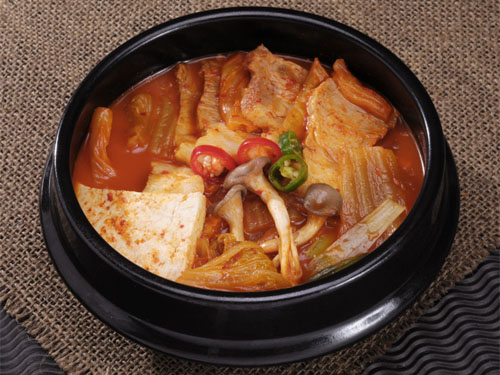
My favourite standard, without fail, dish is 김치찌개kim-chi-jigg-e. It's served as a spicy pot of soup filled with kimchi, pork and any other mix of ingredients like bean-sprouts, tofu, mushrooms. Its flavour comes from the kimchi, and the more there is, the tastier it is and the spicer it is. This dish is made even better (you have to find a good restaurant for this) by the abundant side dishes it's served with. Its perfection comes from it's simplicity and the satisfaction on any day of the year is unparalleld.

Im getting distracted and hungry. As varied as Korean food, is the enormous number of soup varieties; 미역국mi-yeok-guk / a kind of seaweed soup, 된장찌개dwen-jang-jiggae / a seafood soup with dwenjang as a base, 매운탕me-un-tang / spicy fish soup, often eaten after raw fash, 해장국he-jang-guk / an amazing hangover cure made with pig spine... The list goes on and on.
As you would expect from Korean there are many words for soup, the main ones being as above, 국guk, 찌개jji-ge, 탕tang and even the Konglish 슾seup / soup in a packet soup (I think it also goes for french style creamy soups). To the English native speaker, they all seem pretty similar (except for maybe 슾seup / soup in a packet soup (I think it also goes for french style creamy soups)). On the watery side with a very strong and spicy flavour. No mashing involved like in our soups, no milk, parsley or cream either. Yet for Koreans, these soups couldn't be more different. For the culinary explorer I have made the following short guide to Korean soup. (tomorrow)

Tuesday, 22 May 2012

Consideration and Kindness

One of the best things about Korea is the kindness and helpfulness of the people here. People go out of their way to help a confused or lost foreigner. Being "considerate" is one of the most valued character traits in Korea. At dinner the reason everyone is so keen to pour you another glass or stock you up on whatever's been finished is because they want to show they are thinking about you.

But, they're not really thinking about you. They're thinking about a foreigner, or rather what they think a foreigner is, wants, likes and doesn't like. They even try to guess what you know and don't know. If you've been in Korea a while, you might have noticed that although they are extremely congenial and polite, sometimes they just don't answer a question. Especially if it's about something which they think you don't know or do.

In fact, Koreans spend so much time worrying about what you're thinking that they don't actually hear the words you're saying. A prime example of this was in one of my English classes with one of my best students (he improved amazingly in just 2 months). I told him "At the weekend we rented a car and drove to Namhaedo". Bear in mind this is a high level class... He pulled an extremely confused face, didn't say anything for a while and then "But taking a taxi there is very expensive". Before you all go and say "he didn't understand you..." Let me just point this out: "rent a car" in Korean is 렌트 카ren-tuh caa Furthermore I never mentioned a taxi which is also the same word in Korean. He simply could not believe that a foreigner could drive in Korea, let alone rent a car. He was being "considerate" and showed concern at what he assumed was something very irrational (but logical because Im a foreigner).

Another experience happened on a train, fair enough, my Korean is terrible and in all likelihood wrongly phrased. Also my question was in a way answered. I asked the conductor on a train "기차는 대구 역에 가요?"gi-cha-neun daegu-yeok-e ga-yo? / does the train go to daegu station? He proceded with a long list of all the stops between where we were and Seoul including what time the train got there. So fair enough, he did actually tell me that it was stopping at the station, but he didn't answer the question. So my response was "how weird!" What was a Korean friend's take on all of this? "how considerate!". He was covering all the angles and thinking about me, not actually listening to what I was saying, but rather trying to help what he saw as a lost foreigner.

I have had countless experiences like this, and it's only now that I've realised when Koreans take a long time to answer something, or give a strange answer, it's not about understanding. They are trying to fit an answer to you, not to your question. Korean culture (and in my experience, most culture except for the Anglo-Saxon/Northern European culture) is more about performing social function than giving information. Which explains why we Brits are sometimes taken aback by how respectful other cultures are, but it also explains why they talk so bloody-much!

Wednesday, 2 May 2012

Exclamation particles day 3: –잖아-

The final exclamation particle we will look at is –잖아-jan-a (on all verbs). This one means that it is obvious or known to the speaker and to the person being spoken to. ie, it means “duh”. So remember, just like you wouldn’t say “duh” to your grandmother, never say it to an 아줌마/아저씨ajumma/ajo-sshi - middle aged man/woman etc. in Korea!

Ok, so it doesn't always mean duh, another softer translation would be "can't you see"? or "don't you know?" You probably wouldn't say that to old people either though!

Also remember, it isn't just for answering questions (the questions just give a bit of context) It is for stating the obvious Which is often followed by a dumb or unthoughtout question.

Koreans use exclamation particles a lot when speaking and if you ever want to come close to sounding like a native speaker, you have to too. Also when you learn the endings, remember them with a surprised or shocked or happy etc. intonation. Their meaning will not be difficult to remember and using them won’t be as hard. Like the smile, the sound of exclamation is pretty universal.

Saturday, 28 April 2012

Exclamation particles: -네- day 2

Continuing on the theme of "exclamation particles" (I just made that up, sounds good doesn't it?), today's post is about –네--nae- (on all verbs). Although it has a very similar meaning to –는군--neungun-it’s actually less restrictive, because you can say this when you realise or learn something new, even when you can’t see it firsthand.

But of course, this can be used when you experience something too, and it also has a more formal flavour to it.

Coming up tomorrow, my personal favourite, –잖아-jan-a

Thursday, 26 April 2012

Exclamation particles -군-, -네- & -잖아- (Day 1)

One of the biggest differences between Korean and European languages is the use of particles or endings where a European language speaker would use intonation to give an added meaning to the word or phrase.

Just try saying this: “it’s raining”. That’s just a statement of fact. But what if you say “it’s raining” in a surprised tone of voice? Does the meaning change? Perhaps it means you’ve just looked outside and seen the rain. Or you’ve just woken up in your tent and your friend looks very wet. Try saying it in a disappointed tone of voice. What does it mean now? When you say this word using different intonation, you’re definitely not just imparting the fact that it is raining.

When we write, all intonation is lost, so as Europeans, we invented punctuation to help the reader understand. So when you see this: “it’s raining!” you understand surprise or happiness. When you see this “it’s raining?” you understand disappointment or disbelief (obviously not limited to these meanings, context helps you understand exactly what’s going on).

Koreans never needed punctuation because the words themselves change as well as the intonation. To better understand their function, see these endings as a spoken form of punctuation.

First let's look at the most common one:–는군--neungun- (on verbs) and –군--gun- (on descriptive verbs). In the past it’s always –았/-었군--at/-otgun, regardless of the type. You use this ending when you realise something you didn’t know already (surprise). The important thing to remember about this is that you only say it when you see it:

Remember these endings are used in speaking or reported speaking, just like question marks and exclamation marks. It has no place in an essay or newspaper article.

Coming up tomorrow, -네--nae-

Friday, 20 April 2012

Baseball, Junk Food & why Koreans say "화이팅"

To all my (imaginary/non-existent) readers: I am sorry for not putting up any new posts recently. But to get into the habit of "bloggingI really hate this word, it sounds like what happens when you do too much poo in a toilet" I need to persevere. As Koreans would say "화이팅h-wa-eeting / what you say to encourage people or yourself!"So I thought I would do a cultural post...

Korean is full of English words, it's even more full of Chinese words, and there's a noteable absence of Japanese words, although many words in Japanese are similar to Korean because they have a common Chinese root. Furthermore, Korean has some words in common with Japanese because of their English roots too, but even more interestingly some English words have entered Korean through Japanese.

The standard Korean romanisation and pronunciation of "f" is "ㅍpronounced like the "p" in "people". "Fast food" becomes 페스트 푸드"pest pood" / hehehehe or "fry" becomes "프라이"p-er-r-a-ee / not as funny etc. etc. Sticking to the theme of unhealthy dietary habits "French fries" can be written "후렌치 후라이hoo-rench-ee hu-ra-ee"" Here the "f" is changed to a "ㅎpronounced like "h" in "happy"". And "화이팅h-wa-eeting / what you say to encourage people or yourself!" is exactly the same. Which, if you haven't guessed already, is actually a mangled "fighting".

The reason for this variation is pretty simple. When English words come to Korean from Japanese, they maintain their Japanese pronunciation. Just as Korean has no "f" sound, neither does Japanese, but Japanese renders "f" as an "h" sound. Every time you hear an "f" in an English word pronounced or written in this way in Korean, it means that the word has entered the language through Japanese.

The word "화이팅h-wa-eeting / what you say to encourage people or yourself!" in Korean is from baseball, and can be heard at any game. Although baseball is obviously an American export, popular in many of the USA's pseudo-colonies, baseball came to Korea much later than Japan. Because of the geographical closeness, cultural and political exchanges throughout history, baseball in Korea has been influenced, and even modelled on the Japanese version of the game. It is clear that "화이팅h-wa-eeting / what you say to encourage people or yourself!" orginated in Japanese.

The only place I've seen "후렌치 후라이hoo-rench-ee hu-ra-ee"" is on a sign in the cafeteria in the university. This not only dates the sign as this spelling is outdated, it shows that the Japanese brought French Fries to Korea before America, or at least before new transliteration rules. We can't just blame the Americans for exporting Junk food!

By looking simply at the pronounciation and transliteration of a word we can understand so much more than what it means. It can tell us about where the word came from or even a little about who is saying it.

Monday, 9 April 2012

REPEAT!!!

Some days this is really how I feel they teach us, and this is how they the way we learn. The only way is to constantly, repetitively and ceaselessly chip away at the mind with example sentences. No context, no variety, no interest, and as long as you can write an example sentence, you "know" it.

This is a sketch I did while both my teachers failed extremely successfully at explaining a semantically complex ending. "Look the students don't understand! Lets give them 3 hours of explanation and then command them to make example sentences off the top of their heads. Then give more explanations and then make them create more example sentences. It doesn't work? Let's do the same thing tomorrow and again and again until they just say 'yes we understand' to make us stop."

Guess how many students actually tried making example sentences? 2 out of 14. So 2 out of 14 actually did something. The rest? Silence. And because there was no context it was just a mad guessing game anyway.

Some days I just want a refund