Food is ubiquitous in Korea and its variety, quality and uniqueness put it on a par with any of the other great culinary nations. Food is one of the main reasons why I came to Korea in the first place and if you take into consideration that it's a small, cold country, Korean food is even more impressive. (Compare it to the small, cold country I come from, for example).

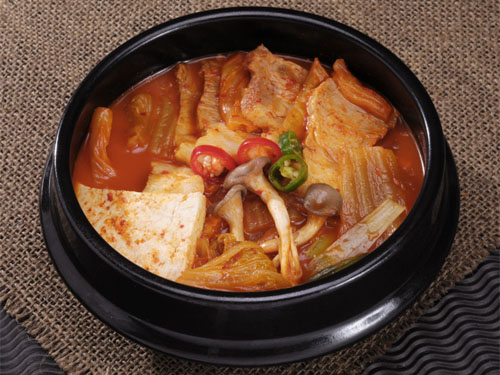
My favourite standard, without fail, dish is 김치찌개kim-chi-jigg-e. It's served as a spicy pot of soup filled with kimchi, pork and any other mix of ingredients like bean-sprouts, tofu, mushrooms. Its flavour comes from the kimchi, and the more there is, the tastier it is and the spicer it is. This dish is made even better (you have to find a good restaurant for this) by the abundant side dishes it's served with. Its perfection comes from it's simplicity and the satisfaction on any day of the year is unparalleld.
Im getting distracted and hungry. As varied as Korean food, is the enormous number of soup varieties; 미역국mi-yeok-guk / a kind of seaweed soup, 된장찌개dwen-jang-jiggae / a seafood soup with dwenjang as a base, 매운탕me-un-tang / spicy fish soup, often eaten after raw fash, 해장국he-jang-guk / an amazing hangover cure made with pig spine... The list goes on and on.
As you would expect from Korean there are many words for soup, the main ones being as above, 국guk, 찌개jji-ge, 탕tang and even the Konglish 슾seup / soup in a packet soup (I think it also goes for french style creamy soups). To the English native speaker, they all seem pretty similar (except for maybe 슾seup / soup in a packet soup (I think it also goes for french style creamy soups)). On the watery side with a very strong and spicy flavour. No mashing involved like in our soups, no milk, parsley or cream either. Yet for Koreans, these soups couldn't be more different. For the culinary explorer I have made the following short guide to Korean soup. (tomorrow)