Showing posts with label korean. Show all posts

Wednesday, 15 August 2012

The reasons Why Korean has so many words 4: Social Reasons Again

Last time I discussed how Korean society used to be caste dominated and how each caste had their own "language" which became part of modern Korean with the arrival of democracy. But even with democracy, Korean society and language continued to be layered.

That's right, it's still layered by age. So you still need all the polite and respectful duplicate words to talk to older people. And older people need to use all the duplicate words to talk down to younger people. Not to mention all the words they use to talk amongst themselves!

Old people, who do not have so much contact with popular culture, use old words for things which young people would use English words for nowadays. Young and old people alike will use special words and phrases, on purpose, in order to show their age and status. And this is another reason why Korean has so many words.

If you want to talk to older or more important people than you, here are the most common polite forms (honorific or humilific) of normal words:

Tuesday, 14 August 2012

The reasons Why Korean has so many words 3: Social Reasons

Last time I discussed how many, many Korean words come from other cultures. However, many many Korean words are also a product of Korean culture and social history too.

Much like India, Korea had a caste system. As a cultural-Brit, I always assumed a caste-system was much like a class-system. Basically, top, middle bottom. What a European way of thinking! Caste-systems are far more complicated than this. You have upper and lower and middle castes, but each caste is more of a represtantion of your specific role in society, not a designation of wealth.
Your job or rather your father's job decided your caste. Basically manual labourers were in the bottom layers of society, but each different job was considered higher or lower than the next. People never intermarried even at those levels. It wasn't just princesses and paupers who couldn't see each other. It was carpenters and masons who couldn't get married. These strict, clear distinctions created a very distinctly layered society.

This solid layering created a society where the only caste mixing took place when trading or doing business. Each caste would have spoken their own language to same-caste-members. There wasn't just "one Korean". But, there wasn't simply a "common language" either. When communicating with higher or lower caste members, people used language specifically designed to talk up or down to people. Just look at all the different speech levels in use today.

So historically, the Korean language had many different branches spoken by many different people. When Korea became a democracy in the 1990s, the caste-layers were blended into one new society. As social barriers broke down, suddenly, all the language and words which were only used by one caste became part of a much larger language which is modern Korean today, growing and multiplying the number of words.

Footnote 1: I am talking about official Korean here, the Korean which is taught to foreigners. There are still many different kinds of Korean.

Footnote 2: Just because the caste system was abolished by no means does this mean the wealth was redistrubted. Generally 양반yang-ban / the top or warrior and scholar caste still have all the money, they just don't wear the hats any more!

Monday, 13 August 2012

The reasons Why Korean has so many words 2: English & 한자 (hanja) the hidden terror behind Korean words

Last time we saw that the very nature of Korean is to have many words because Korean doesn't really use patterns to create meaning. As a result of this, Korean is extremely open to new words from other languages.

Anyone who is familiar with Korea has been baffled, amused, concerned and surprised by the huge amount of English words that have come to Korean and are in every day use. With America as the only superpower and political antithesis to China, Koreans have embraced many aspects of their culture and language.

But long ago, when the world was a different place, Koreans were doing the same thingno surprise here with language. Back then China was the political and cultural centre of Asia. So naturally Korean is full of Chinese too (I've heard about 50% of the words). Before Korean had an alphabet and even after Korean had an alphabet, everything was written in Chinese characters. In a similar way like Latin influencing European languages Chinese did the same thing.

Originally these words came to the language through scholars, traders and politicians (the educated and therefore high classes). So more often than not there is a "pure" Korean equivalent to a word of Chinese origin, which the lower classes would have in common use, resulting in two words with the same meaning.

Even nowadays suffering Korean children are made to memorise countless Chinese characters which form the backbone of so many words. But there is a logic to this, much like English becomes Koreanised So have these characters and Koreans use them as building blocks for making new words which have no Chinese equivalent.

Korean needs words to create meaning. So by absorbing and adapting foreign words they can satisfy that need, often resulting often in duplicate and triplicate synonyms.

Tomorrow one more reason why Korean has so many words!

Sunday, 12 August 2012

The reasons Why Korean has so many words 1

As a student of Korean you can go pretty crazy with the sheer number of synonyms a word can have, and you should learn them all! I first came across this when I started learning family members. For example there are more than three words for wife: 부인, 아내, 집사람bu-in, an-e, jip-sa-ram or child: 자식, 아이(애), 어린이ja-shik, a-i(e), eo-ri-ni. And these are just ones I've heard in conversation or come across in class!

It doesn't stop with nouns or even people, sometimes it seems like there are at least three words for everything in Korean. And by three words, I mean three words that are used every day. Know any other words for children in English? How about progeny or offspring? These are words used in horror films or dusty tomes. (look! another word for book!).

So why is that there are so many more words in use in Korean?

The underlying reason for this is the nature of Korean. Korean words do not change according to their role in the sentence.
In fact the only words which change at all are verbs, and they only change a little. Compare that to English with over 100 irregular verbs. And then bear in mind there are also irregular nouns in English - what's the plural of man, woman, child, person? Or how about adjectives? big - bigger, good - better. This does not happen at all in Korean.

However the point that I am making is not that there are exceptions in English. The point is that there are patterns in English. Korean has very few patterns. So instead of meaning coming from patterns, meaning comes from words and particles

자식ja-shik means something more like "my child(ren)" so you wouldn't use it for some children you saw on the street. In English we just attach "my" to show this relationship or "some" to show that there is no relatiosnhip. Words like "my" "some" or "any" can be attached to any noun and always mean the same thing. ie They follow a pattern. Korean doesn't have this pattern, so in every case of "my" you need a new word.

On the other hand 어린이eo-ri-ni is more of an official word for child. So you see childcare centres called "어린이 집"eo-ri-ni jip / children's house or "children's" tickets as opposed to "adults". So often 어린이eo-ri-ni has a plural sense to it. In English we would just change child to children.

So where English uses an established pattern to change the meaning of a word, Korean instead uses a specific word for each different situation. And that's one reason why Korean has so many words!

In the next post. More reasons why Korean has so many words.

Saturday, 30 June 2012

Korean Basics: making a sentence

Maybe you can remember back to school days, or you’re an English teacher yourself? A sentence in English always needs at least 2 things, and normally more. But the two main things are:

  • a subject – they, she, it, the cat, a bird, my evil twinetc. etc.
  • a verb – eat(s) / swim(s) / run(s) / murdered etc. etc. (a doing word)

So “yes!” is not a sentence and “hungry” is not a sentence either, although you can kind of get what they mean. But what happens if you say “love”? Can you understand the meaning? Who do you love? Who loves you? Do you hate love? Is love great? can your evil twin love? It’s confusing, and it definitely is not a sentence.

In the last basics post I talked about verb endings and politeness. When we use them, it means that we are talking to someone. In English, it's the oppposite, our sentences show that someone is talking, that's why we always need a subject. Without a subject it's difficult to guess who is talking (see above).

Love in Korean is 사랑하다sarang-hada. This is the base form (remember) So when we put an ending on it means that there must be someone you're talking to because you are either showing, or not showing respect.
So imagine your mum is in front of you and you say 사랑해요sarang-hae-yo. In English this literally translates as "love" But of course, if your mum's in front of you, a better translation would be "I love you".

Korean, unlike English, does not need a subject, and often it does not need an object either (what comes after a verb, not before, like the "you" in "I love you"). You can work it out from the situation. So any verb with an ending on it, is in fact a sentence in Korean. So take any verb and put an ending on it! Congratulations! You're speaking Korean in full sentences

But of course sometimes you need to put these words in. Imagine there are three girls/boys in front of you. You want to tell one you love them. If you just say 사랑해요sarang-hae-yo they'll all think you love them!

Sunday, 24 June 2012

국, 탕, 찌개, glorious soup!! - 탕 / tang

tang, not to to be confused with the Tang dynasty, is usually made with fish. It's most common incarnation is as 매운탕me-un-tang, a mixture of fish bones and heads from the hoe/(pronounced hw-eh) making process. It's sometimes free or costs just a little extra. It's name means spicy soup, so you have been warned. Also it can be a little awkward to eat because of all the fish bones. You've been warned a second time!
Like guk, tang is quite watery, but it contains many different ingredients, including moo / a massive mild radish and different kinds of spring-onions.

Wednesday, 20 June 2012

국, 탕, 찌개, glorious soup!! - 국 / guk

guk is probably the most common kind of soup. It generally has the highest ratio of water to ingredients. It's made from stock, which characterises this kind of soup. Generally it doesn't have many ingredients, either beef and some kind of cabbage - 소고기국(밥)so-go-gi-gukbap / beef soup and rice. Other varieties contain pretty much only noodles.

칼국수kal-guk-su is wheat noodles (a lot like homemade linguine) in broth. The taste is mild and it can contain clams, and other seafood depending on the variety. The noodles themselves are often homemade and make the soup soft and hearty.

잔치국수kal-guk-su is a must have. It's simple and filling and most importantly cheap. Even the most hardened Korean-food hating westerner can't dislike this. It's basically spaghetti like noodles in fish stock or broth (often you can't even tell that it's made from fish)You add your own flavouring, generally a few spring onions in soy sauce. At 2000won a hit, you cant go wrong. Also, in the summer it's served at room temperature, so the only sweating you'll be doing is from eating it too fast!

국, 탕, 찌개, glorious soup!! - 된장찌개 - dwenjang-jjig-e

찌개jji-ge, mis-translated by Koreans as stew (much to the dissapointment of the international community, and something which I will discuss in the next post), is similar to tangin terms of quantity of ingredients. What makes it different is that the flavour comes, not from meat, fish, or stock, but fermented produce, either 김치kimchi or 됀장dwen-jang. Both these ingredients can be quite strong, so what turns out is a surprisingly rich and hearty, yet still very liquidy soup.
된장찌개dwen-jang-jigg-e normally contains clams or shrimps. Just like 김치찌개kim-chi-jigg-ae it also can contain tofu, chillis, spring onions etc. Like tang a good 찌개jji-ge should have many more ingredients than liquid. If it doesn't, the restaurant is skimping on costs.

국, 탕, 찌개, glorious soup!! - Kimchi-jigge

Food is ubiquitous in Korea and its variety, quality and uniqueness put it on a par with any of the other great culinary nations. Food is one of the main reasons why I came to Korea in the first place and if you take into consideration that it's a small, cold country, Korean food is even more impressive. (Compare it to the small, cold country I come from, for example).

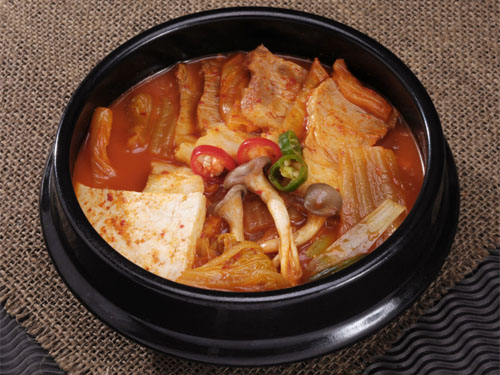
My favourite standard, without fail, dish is 김치찌개kim-chi-jigg-e. It's served as a spicy pot of soup filled with kimchi, pork and any other mix of ingredients like bean-sprouts, tofu, mushrooms. Its flavour comes from the kimchi, and the more there is, the tastier it is and the spicer it is. This dish is made even better (you have to find a good restaurant for this) by the abundant side dishes it's served with. Its perfection comes from it's simplicity and the satisfaction on any day of the year is unparalleld.

Im getting distracted and hungry. As varied as Korean food, is the enormous number of soup varieties; 미역국mi-yeok-guk / a kind of seaweed soup, 된장찌개dwen-jang-jiggae / a seafood soup with dwenjang as a base, 매운탕me-un-tang / spicy fish soup, often eaten after raw fash, 해장국he-jang-guk / an amazing hangover cure made with pig spine... The list goes on and on.
As you would expect from Korean there are many words for soup, the main ones being as above, guk, 찌개jji-ge, tang and even the Konglish seup / soup in a packet soup (I think it also goes for french style creamy soups). To the English native speaker, they all seem pretty similar (except for maybe seup / soup in a packet soup (I think it also goes for french style creamy soups)). On the watery side with a very strong and spicy flavour. No mashing involved like in our soups, no milk, parsley or cream either. Yet for Koreans, these soups couldn't be more different. For the culinary explorer I have made the following short guide to Korean soup. (tomorrow)

Wednesday, 2 May 2012

Exclamation particles day 3: –잖아-

The final exclamation particle we will look at is –잖아-jan-a (on all verbs). This one means that it is obvious or known to the speaker and to the person being spoken to. ie, it means “duh”. So remember, just like you wouldn’t say “duh” to your grandmother, never say it to an 아줌마/아저씨ajumma/ajo-sshi - middle aged man/woman etc. in Korea!

Ok, so it doesn't always mean duh, another softer translation would be "can't you see"? or "don't you know?" You probably wouldn't say that to old people either though!

Also remember, it isn't just for answering questions (the questions just give a bit of context) It is for stating the obvious Which is often followed by a dumb or unthoughtout question.

Koreans use exclamation particles a lot when speaking and if you ever want to come close to sounding like a native speaker, you have to too. Also when you learn the endings, remember them with a surprised or shocked or happy etc. intonation. Their meaning will not be difficult to remember and using them won’t be as hard. Like the smile, the sound of exclamation is pretty universal.

Saturday, 28 April 2012

Exclamation particles: -네- day 2

Continuing on the theme of "exclamation particles" (I just made that up, sounds good doesn't it?), today's post is about –네--nae- (on all verbs). Although it has a very similar meaning to –는군--neungun-it’s actually less restrictive, because you can say this when you realise or learn something new, even when you can’t see it firsthand.

But of course, this can be used when you experience something too, and it also has a more formal flavour to it.

Coming up tomorrow, my personal favourite, –잖아-jan-a

Thursday, 26 April 2012

Exclamation particles -군-, -네- & -잖아- (Day 1)

One of the biggest differences between Korean and European languages is the use of particles or endings where a European language speaker would use intonation to give an added meaning to the word or phrase.

Just try saying this: “it’s raining”. That’s just a statement of fact. But what if you say “it’s raining” in a surprised tone of voice? Does the meaning change? Perhaps it means you’ve just looked outside and seen the rain. Or you’ve just woken up in your tent and your friend looks very wet. Try saying it in a disappointed tone of voice. What does it mean now? When you say this word using different intonation, you’re definitely not just imparting the fact that it is raining.

When we write, all intonation is lost, so as Europeans, we invented punctuation to help the reader understand. So when you see this: “it’s raining!” you understand surprise or happiness. When you see this “it’s raining?” you understand disappointment or disbelief (obviously not limited to these meanings, context helps you understand exactly what’s going on).

Koreans never needed punctuation because the words themselves change as well as the intonation. To better understand their function, see these endings as a spoken form of punctuation.

First let's look at the most common one:–는군--neungun- (on verbs) and –군--gun- (on descriptive verbs). In the past it’s always –았/-었군--at/-otgun, regardless of the type. You use this ending when you realise something you didn’t know already (surprise). The important thing to remember about this is that you only say it when you see it:

Remember these endings are used in speaking or reported speaking, just like question marks and exclamation marks. It has no place in an essay or newspaper article.

Coming up tomorrow, -네--nae-

Monday, 9 April 2012

REPEAT!!!

Some days this is really how I feel they teach us, and this is how they the way we learn. The only way is to constantly, repetitively and ceaselessly chip away at the mind with example sentences. No context, no variety, no interest, and as long as you can write an example sentence, you "know" it.

This is a sketch I did while both my teachers failed extremely successfully at explaining a semantically complex ending. "Look the students don't understand! Lets give them 3 hours of explanation and then command them to make example sentences off the top of their heads. Then give more explanations and then make them create more example sentences. It doesn't work? Let's do the same thing tomorrow and again and again until they just say 'yes we understand' to make us stop."

Guess how many students actually tried making example sentences? 2 out of 14. So 2 out of 14 actually did something. The rest? Silence. And because there was no context it was just a mad guessing game anyway.

Some days I just want a refund

Friday, 6 April 2012

(-은/는) -대로 That's the way I like it!

(-은/는) -대로(-eun/neun) -daero is a really useful little conversation helper which basically means "the way it is/does". Way and road are synonyms by the way... Just to help you remember.
-대로 -daerocan attach to verbs using -은/는 -eun/neun and it can attach to nouns on it's own.
Have a look at the example sentences:

It's tempting to translate this ending as "like" - "I cooked it like it is in the cookery book" / I set the computer up like it is in the instructions. But this is a mistake. It means in the same way as it says/does/is.

Both the above examples show that you do not want to be like the teacher or Michael Jackson, you only want to do what they do in the same way. Just like you don't want to be like the cookery book, you want to cook the way it tells you to cook!

Wednesday, 4 April 2012

On the Road to -(으)로

-(으)로-(eu)ro is one of the closest things to a preposition that Korean has, but remember it isn't a preposition, it's an ending. It's basic meaning is to imply direction, something like to or towards. What helps me remember it is that it sounds a lot like "road". A road takes you to where you want to go, but it is not your destination.

When used with 하다hada / do, -(으)로-(eu)ro takes on a meaning like "go for" in English. It implies that you have made a thought out choice. For example when you're in a restaurant.

So just like "go for" it shows a decision or intent, while also using some words which imply movement.

But just to make it interesting we can use it with verb forms too. Just drop the -다-da, add -기-gi and -로-ro. And of course Don't forget 하다hada!

So when there is a verb it means a plan or intent. It can even mean a promise, as in the second example. And in fact, instead of 하다hada you can use other verbs like 결정하다gyeol-jong hada / decide or 약속하다yaksok hada / promise or 결심하다gyeol-shim hada / to be determined to to give it that extra special meaning:

And who said Korean was difficult????

Monday, 2 April 2012

English이란 어려워요!!!!

For a language that has so many words which change depending on speaker and person being spoken to, it's odd that the verbs to borrow and to lend are the same: 빌리다billida. How then do they distinguish them? The answer's quite easy, they use the verb 주다juda / give:

In English, "give" is a very uninteresting verb, but In Korean it has a grammatical function too. It essentially gives the idea that the subject of the verb is doing someone else a favour.

This is one reason why Koreans often struggle with the difference between to/for. They learn that "to" and "for" are both -에/-에게-ae/-aegae. But for once it's English that has a specific meaning. The preposition "for" in itself implies a favour, whereas the ending -에/-에게-ae/-aegae" just means "not the subject or object".

Many learners of Korean (are encouraged to) complain that Korean is difficult, but for once there isn't a specific verb for a specific situation! English is the difficult language. In fact, are there any European languages that use a totally different item of vocabulary? I can't think of any at the moment.


English이란 어려워요!oer-yeo-weo-yo / is difficult

Friday, 30 March 2012

...the dog ate my homework and other excuses

So today I’m missing the first class and I’m going to use various excuses, but there is one reason in particular. Every so often we spend the first lesson of the day practising rote-learned dialogues from the textbook.

I am going to stay as culturally neutral as possible, but this is a total waste of time. I waste more than 30 minutes memorising it of my free time, I waste 2 minutes in class reciting it, and then I waste the next 48 minutes of class listening to other people saying the same thing over and over again. This is a totally outmoded and anachronistic learning method.

Lets go back 2000 years to the time of the great Roman poets, when there were no computers, there were no books and there was very little paper. In these times, the only way to remember large quantities of new vocabulary was to put them into your head, by literally learning books off by heart. Instead of referring to a page in your notebook, you could go into your memory and find the right lines etc, or even more likely, be reminded of the word when you hear it.

When you were a child do you remember misunderstanding songs, and only realising what the words meant later in life, but you could sing the song perfectly anyway? Learning things off by heart does not help you to use and understand new vocabulary. It helps you to recite the things that you have learned off by heart. Anyone can learn any group of sounds together, you don’t need to know what they mean in order to do this.

This teaching method is totally irrelevant to modern day life, is highly inefficient and ultimately pretty much useless. It restricts you to only the learned conversations, it makes you unable to put your own sentences together and it destroys your confidence in the language. By learning like this you will never understand anyone because people don’t speak the exact same dialogues as in the textbook.

그래서 선생님, 내가 결석 했다geureseo, seonsengnim, naega gyeolseok haedda / check google translate to see what that means

거든(요)

-거든(요)-geodeunyo is a phrase that I remember hearing continuously since I have been in Korea. It's really stuck! Perhaps it's because it goes at the end of a sentence and it often stressed. According to the teacher it's just another way for giving a reason, but then of course why would they have it? There are a million words for "because" in Korean. Luckily I have the infinite resources of the internet and Korean acquaintances.
  • Firstly it doesn't require a qualifying clause, it simply gives a stand-alone reason “Because I’m hot.”
  • Secondly it is emphatic because of its position and intonation, so rather than meaning "because..." it means "it is because..."
  • Thirdly it stands out because it gives the other person you're talking to a chance to respond. It has a conversational function as the Korean grammar dictionary translates it, you can insert a "you see."

Ultimately explaining it isn't enough. You need to use it, and listen out for it whenever you can!

Colours in Korean

As a young child exposed to the vulgarity of philosophy, I was posed the question is blue blue? Well of course it bloody is. I think the point was that everyone sees colours differently so blah blah blah. A lovely linguistic cliché is to discuss the fact that different languages cultures have different concepts of colour and don't have certain colours at all. I have not yet come across a language like this in my experience, so I can't comment (though someone told me that Latin colours were more about brightness.)

Anyway as you would guess, Korean has many words for colour and of course many different colours. A great similarity between English being the poetic '파루다'pareuda it is azure to "파랗다"parata it is blue. The former being used for only natural phenomena. Intriguingly, traffic lights, despite being the same here as in any country, are referred to as turning blue "파래 지다"parae jida and not green. As far as I've learnt there is no adjectival/verbal form for green! Philosophers please don't get too excited.

Furthermore it seems like the phrase "my hat is red" "내 모자가 빨간색이에요"nae mojaga bbalkanseki-ye-yo or "내 모자가 빨개요"nae mojaga bbalkayo mean exactly the same thing... Although I think it is more likely that their difference is the difference between "좋아요"jo-ayo / it is good and "좋아 해요"jo-a-heyo / I like it(it is good). One meaning something like "its nature is red" and the other "it is red". Anyway I don't really understand why Korean has so many verbal pairs like this, but the more I learn, the more (however slowly) I understand.

How to talk to yourself in Korean

I don't want to write another post about today being slow, but it was slow... We practised the forms which go with the "plain style" (Korean grammar for international learners, Yonsei university press). Basically sticking -ㄴ/는다-n/-neunda on the end of verbs thus removing any kind of respect form endings. Interestingly the -시--shi- is maintained, and even more interestingly in the first person only the pronoun "나"na / I is acceptable.

The teacher told us that this form is generally used in writing, especially in newspapers and other accounts. According to my grammar book it is a form of paraphrasing, ie not relating the story directly, but rather indirectly. Note how in German and Italian the subjunctive can be used in similar contexts.

However 1st person stories in this style are permissible. Another European point of comparison would be from English grammar, teaching all verbs with their particle "to" eg. "to eat" rather than "eat"

Perhaps though, the most interesting aspect of this form is that it used for talking to yourself. As you have special forms for talking to older, younger, more important and less important people in Korean, there is also a form for having "one on one" conversation!

I've often heard Koreans saying quite loudly, but not to anyone: "춥다"chupda / It's cold and "맛있겠다"mashigetta / that looks delicious!. Often though this is in a group of friends, and often also when the conversation lulls. This is something which is also common to the Japanese (apparently). I have always been a little confused as to how to respond, but I suppose the very nature of this form is that it requires no response!