Showing posts with label in korean. Show all posts

Sunday, 24 June 2012

국, 탕, 찌개, glorious soup!! - 탕 / tang

tang, not to to be confused with the Tang dynasty, is usually made with fish. It's most common incarnation is as 매운탕me-un-tang, a mixture of fish bones and heads from the hoe/(pronounced hw-eh) making process. It's sometimes free or costs just a little extra. It's name means spicy soup, so you have been warned. Also it can be a little awkward to eat because of all the fish bones. You've been warned a second time!
Like guk, tang is quite watery, but it contains many different ingredients, including moo / a massive mild radish and different kinds of spring-onions.

Wednesday, 20 June 2012

국, 탕, 찌개, glorious soup!! - 국 / guk

guk is probably the most common kind of soup. It generally has the highest ratio of water to ingredients. It's made from stock, which characterises this kind of soup. Generally it doesn't have many ingredients, either beef and some kind of cabbage - 소고기국(밥)so-go-gi-gukbap / beef soup and rice. Other varieties contain pretty much only noodles.

칼국수kal-guk-su is wheat noodles (a lot like homemade linguine) in broth. The taste is mild and it can contain clams, and other seafood depending on the variety. The noodles themselves are often homemade and make the soup soft and hearty.

잔치국수kal-guk-su is a must have. It's simple and filling and most importantly cheap. Even the most hardened Korean-food hating westerner can't dislike this. It's basically spaghetti like noodles in fish stock or broth (often you can't even tell that it's made from fish)You add your own flavouring, generally a few spring onions in soy sauce. At 2000won a hit, you cant go wrong. Also, in the summer it's served at room temperature, so the only sweating you'll be doing is from eating it too fast!

국, 탕, 찌개, glorious soup!! - 된장찌개 - dwenjang-jjig-e

찌개jji-ge, mis-translated by Koreans as stew (much to the dissapointment of the international community, and something which I will discuss in the next post), is similar to tangin terms of quantity of ingredients. What makes it different is that the flavour comes, not from meat, fish, or stock, but fermented produce, either 김치kimchi or 됀장dwen-jang. Both these ingredients can be quite strong, so what turns out is a surprisingly rich and hearty, yet still very liquidy soup.
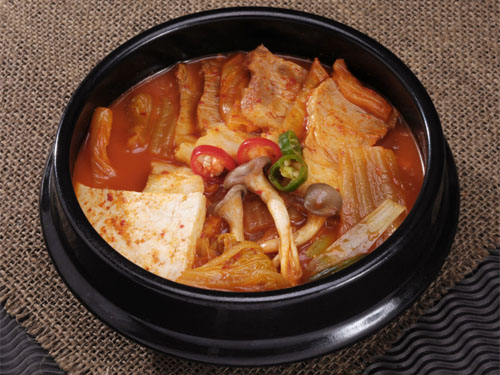
된장찌개dwen-jang-jigg-e normally contains clams or shrimps. Just like 김치찌개kim-chi-jigg-ae it also can contain tofu, chillis, spring onions etc. Like tang a good 찌개jji-ge should have many more ingredients than liquid. If it doesn't, the restaurant is skimping on costs.

국, 탕, 찌개, glorious soup!! - Kimchi-jigge

Food is ubiquitous in Korea and its variety, quality and uniqueness put it on a par with any of the other great culinary nations. Food is one of the main reasons why I came to Korea in the first place and if you take into consideration that it's a small, cold country, Korean food is even more impressive. (Compare it to the small, cold country I come from, for example).

My favourite standard, without fail, dish is 김치찌개kim-chi-jigg-e. It's served as a spicy pot of soup filled with kimchi, pork and any other mix of ingredients like bean-sprouts, tofu, mushrooms. Its flavour comes from the kimchi, and the more there is, the tastier it is and the spicer it is. This dish is made even better (you have to find a good restaurant for this) by the abundant side dishes it's served with. Its perfection comes from it's simplicity and the satisfaction on any day of the year is unparalleld.

Im getting distracted and hungry. As varied as Korean food, is the enormous number of soup varieties; 미역국mi-yeok-guk / a kind of seaweed soup, 된장찌개dwen-jang-jiggae / a seafood soup with dwenjang as a base, 매운탕me-un-tang / spicy fish soup, often eaten after raw fash, 해장국he-jang-guk / an amazing hangover cure made with pig spine... The list goes on and on.
As you would expect from Korean there are many words for soup, the main ones being as above, guk, 찌개jji-ge, tang and even the Konglish seup / soup in a packet soup (I think it also goes for french style creamy soups). To the English native speaker, they all seem pretty similar (except for maybe seup / soup in a packet soup (I think it also goes for french style creamy soups)). On the watery side with a very strong and spicy flavour. No mashing involved like in our soups, no milk, parsley or cream either. Yet for Koreans, these soups couldn't be more different. For the culinary explorer I have made the following short guide to Korean soup. (tomorrow)

Wednesday, 2 May 2012

Exclamation particles day 3: –잖아-

The final exclamation particle we will look at is –잖아-jan-a (on all verbs). This one means that it is obvious or known to the speaker and to the person being spoken to. ie, it means “duh”. So remember, just like you wouldn’t say “duh” to your grandmother, never say it to an 아줌마/아저씨ajumma/ajo-sshi - middle aged man/woman etc. in Korea!

Ok, so it doesn't always mean duh, another softer translation would be "can't you see"? or "don't you know?" You probably wouldn't say that to old people either though!

Also remember, it isn't just for answering questions (the questions just give a bit of context) It is for stating the obvious Which is often followed by a dumb or unthoughtout question.

Koreans use exclamation particles a lot when speaking and if you ever want to come close to sounding like a native speaker, you have to too. Also when you learn the endings, remember them with a surprised or shocked or happy etc. intonation. Their meaning will not be difficult to remember and using them won’t be as hard. Like the smile, the sound of exclamation is pretty universal.

Saturday, 28 April 2012

Exclamation particles: -네- day 2

Continuing on the theme of "exclamation particles" (I just made that up, sounds good doesn't it?), today's post is about –네--nae- (on all verbs). Although it has a very similar meaning to –는군--neungun-it’s actually less restrictive, because you can say this when you realise or learn something new, even when you can’t see it firsthand.

But of course, this can be used when you experience something too, and it also has a more formal flavour to it.

Coming up tomorrow, my personal favourite, –잖아-jan-a

Thursday, 26 April 2012

Exclamation particles -군-, -네- & -잖아- (Day 1)

One of the biggest differences between Korean and European languages is the use of particles or endings where a European language speaker would use intonation to give an added meaning to the word or phrase.

Just try saying this: “it’s raining”. That’s just a statement of fact. But what if you say “it’s raining” in a surprised tone of voice? Does the meaning change? Perhaps it means you’ve just looked outside and seen the rain. Or you’ve just woken up in your tent and your friend looks very wet. Try saying it in a disappointed tone of voice. What does it mean now? When you say this word using different intonation, you’re definitely not just imparting the fact that it is raining.

When we write, all intonation is lost, so as Europeans, we invented punctuation to help the reader understand. So when you see this: “it’s raining!” you understand surprise or happiness. When you see this “it’s raining?” you understand disappointment or disbelief (obviously not limited to these meanings, context helps you understand exactly what’s going on).

Koreans never needed punctuation because the words themselves change as well as the intonation. To better understand their function, see these endings as a spoken form of punctuation.

First let's look at the most common one:–는군--neungun- (on verbs) and –군--gun- (on descriptive verbs). In the past it’s always –았/-었군--at/-otgun, regardless of the type. You use this ending when you realise something you didn’t know already (surprise). The important thing to remember about this is that you only say it when you see it:

Remember these endings are used in speaking or reported speaking, just like question marks and exclamation marks. It has no place in an essay or newspaper article.

Coming up tomorrow, -네--nae-

Monday, 9 April 2012

REPEAT!!!

Some days this is really how I feel they teach us, and this is how they the way we learn. The only way is to constantly, repetitively and ceaselessly chip away at the mind with example sentences. No context, no variety, no interest, and as long as you can write an example sentence, you "know" it.

This is a sketch I did while both my teachers failed extremely successfully at explaining a semantically complex ending. "Look the students don't understand! Lets give them 3 hours of explanation and then command them to make example sentences off the top of their heads. Then give more explanations and then make them create more example sentences. It doesn't work? Let's do the same thing tomorrow and again and again until they just say 'yes we understand' to make us stop."

Guess how many students actually tried making example sentences? 2 out of 14. So 2 out of 14 actually did something. The rest? Silence. And because there was no context it was just a mad guessing game anyway.

Some days I just want a refund

Friday, 6 April 2012

(-은/는) -대로 That's the way I like it!

(-은/는) -대로(-eun/neun) -daero is a really useful little conversation helper which basically means "the way it is/does". Way and road are synonyms by the way... Just to help you remember.
-대로 -daerocan attach to verbs using -은/는 -eun/neun and it can attach to nouns on it's own.
Have a look at the example sentences:

It's tempting to translate this ending as "like" - "I cooked it like it is in the cookery book" / I set the computer up like it is in the instructions. But this is a mistake. It means in the same way as it says/does/is.

Both the above examples show that you do not want to be like the teacher or Michael Jackson, you only want to do what they do in the same way. Just like you don't want to be like the cookery book, you want to cook the way it tells you to cook!

Wednesday, 4 April 2012

On the Road to -(으)로

-(으)로-(eu)ro is one of the closest things to a preposition that Korean has, but remember it isn't a preposition, it's an ending. It's basic meaning is to imply direction, something like to or towards. What helps me remember it is that it sounds a lot like "road". A road takes you to where you want to go, but it is not your destination.

When used with 하다hada / do, -(으)로-(eu)ro takes on a meaning like "go for" in English. It implies that you have made a thought out choice. For example when you're in a restaurant.

So just like "go for" it shows a decision or intent, while also using some words which imply movement.

But just to make it interesting we can use it with verb forms too. Just drop the -다-da, add -기-gi and -로-ro. And of course Don't forget 하다hada!

So when there is a verb it means a plan or intent. It can even mean a promise, as in the second example. And in fact, instead of 하다hada you can use other verbs like 결정하다gyeol-jong hada / decide or 약속하다yaksok hada / promise or 결심하다gyeol-shim hada / to be determined to to give it that extra special meaning:

And who said Korean was difficult????

Monday, 2 April 2012

English이란 어려워요!!!!

For a language that has so many words which change depending on speaker and person being spoken to, it's odd that the verbs to borrow and to lend are the same: 빌리다billida. How then do they distinguish them? The answer's quite easy, they use the verb 주다juda / give:

In English, "give" is a very uninteresting verb, but In Korean it has a grammatical function too. It essentially gives the idea that the subject of the verb is doing someone else a favour.

This is one reason why Koreans often struggle with the difference between to/for. They learn that "to" and "for" are both -에/-에게-ae/-aegae. But for once it's English that has a specific meaning. The preposition "for" in itself implies a favour, whereas the ending -에/-에게-ae/-aegae" just means "not the subject or object".

Many learners of Korean (are encouraged to) complain that Korean is difficult, but for once there isn't a specific verb for a specific situation! English is the difficult language. In fact, are there any European languages that use a totally different item of vocabulary? I can't think of any at the moment.


English이란 어려워요!oer-yeo-weo-yo / is difficult