Showing posts with label jjige. Show all posts

Saturday, 30 June 2012

Why Koreans translate so strangely

I met one of my friends after dinner once (in Korea), and he was visibly upset. He said “There was seaweed in my porridge!” you might think that this is a culinary travesty like jam in fried egg sandwiches, but this time it wasn’t. It was the result of mistranslation

What my friend had, had absolutely nothing to do with porridge. It was something closer to risotto called 죽juk. Rice cooked a long time, served with savoury flavourings like kimchi or octopus or seaweed. But all Koreans call 죽juk “porridge”. You actually see it written outside 죽juk restaurants

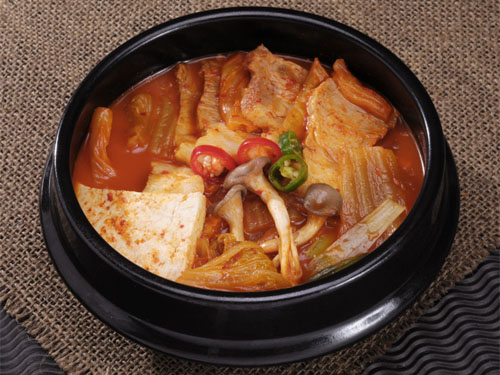
The same goes with 찌개jjigg-ae. Much to the disappointment of new arrivals when they look at a menu, they see this translated as stew. Suddenly potatoes and tender meat in a thick sauce come to mind. You couldn’t be further from the truth. This is soup, plain and simple, albeit delicious.

Of course there are cultural reasons as to why all Koreans categorise these foods like this (I have to admit, I once saw 찌개jjig-ae called soup), but that’s for another time. This is pure conjecture, but I believe that these terms were coined pre-50s.

Porridge is not exactly a commonly eaten food, and to be honest, I am the only person who has such happy feelings when I think about stew. These are both foods of the past, which have been replaced by fancy things like "cereals" and "tagine".
I think that these words entered Korean when, either, the Americans occupied the South in the 1950s, or it could have taken place even earlier with the first missionaries. The Korean language has adopted these words so much that when you say (even in English) “찌개jjig-ae is not stew” no one believes you!

Korean doesnt just create Korean, and it doesn't just create Konglish, it even creates English. These odd translations remain to this day cemented in the Korean language, and will continue to confuse foreigners long into the future.

Wednesday, 20 June 2012

국, 탕, 찌개, glorious soup!! - Kimchi-jigge

Food is ubiquitous in Korea and its variety, quality and uniqueness put it on a par with any of the other great culinary nations. Food is one of the main reasons why I came to Korea in the first place and if you take into consideration that it's a small, cold country, Korean food is even more impressive. (Compare it to the small, cold country I come from, for example).

My favourite standard, without fail, dish is 김치찌개kim-chi-jigg-e. It's served as a spicy pot of soup filled with kimchi, pork and any other mix of ingredients like bean-sprouts, tofu, mushrooms. Its flavour comes from the kimchi, and the more there is, the tastier it is and the spicer it is. This dish is made even better (you have to find a good restaurant for this) by the abundant side dishes it's served with. Its perfection comes from it's simplicity and the satisfaction on any day of the year is unparalleld.

Im getting distracted and hungry. As varied as Korean food, is the enormous number of soup varieties; 미역국mi-yeok-guk / a kind of seaweed soup, 된장찌개dwen-jang-jiggae / a seafood soup with dwenjang as a base, 매운탕me-un-tang / spicy fish soup, often eaten after raw fash, 해장국he-jang-guk / an amazing hangover cure made with pig spine... The list goes on and on.
As you would expect from Korean there are many words for soup, the main ones being as above, 국guk, 찌개jji-ge, 탕tang and even the Konglish 슾seup / soup in a packet soup (I think it also goes for french style creamy soups). To the English native speaker, they all seem pretty similar (except for maybe 슾seup / soup in a packet soup (I think it also goes for french style creamy soups)). On the watery side with a very strong and spicy flavour. No mashing involved like in our soups, no milk, parsley or cream either. Yet for Koreans, these soups couldn't be more different. For the culinary explorer I have made the following short guide to Korean soup. (tomorrow)