Showing posts with label difference. Show all posts

Friday, 6 July 2012

-와/-과, -이랑/-랑, -하고: and, and, and and! (Meaning)

this is a continuation of this post

-하고-hago is used to join nouns together in a list. There is no relationship between them. So imagine you're looking in the fridge and you see rice and kimchi, you don't want to eat them together, you're just saying they're there. Also -하고-hago is used more in writing than speaking.

-랑/-이랑-rang/-irang is used in speaking, and you will often here it in the restaurant when making an order. It has a more general meaning than -하고-hago in the sense it can be used to denote some kind of relationship between people:

-와/-과-wa/-gwa, is used in writing instead of -랑/-이랑-rang/-irang, but generally it has an extra meaning, and is therefore a little different. When you use -와/-과-wa/-gwa you are saying that the two things are linked or have a relatiosnhip:

If you look in the fridge and say "there's rice with kimchi" it means that they are mixed together! In English you can say "I like Kimchi and rice" which can mean "rice with kimchi" but in Korean 밥과 김치bab-gwa kimchi only means "rice with kimchi".

Here are some more examples of -와/-과-wa/-gwa showing a relationship between two things

So -와/-과-wa/-gwa is used when comparing 2 things and to emphasize that there is an exchange or a relationship. In fact -와/-과-wa/-gwa is nearly always used in conjunction with words 함께ham-ggae and 같이ga-chi which roughly mean "together".

-와/-과, -이랑/-랑, -하고: and, and, and and! (Grammar)

Today we are going to see how to put different nouns together, essentially the word "and". There are many ways in Korean to say this word and the difference is quite subtle. Today we will look at the three most common ones: -하고-hago, -와/-과-wa/-gwa, and -랑/-이랑-rang/-irang.

First of all lets look quickly at where to put these particles. You can attach -하고-hago to anything without changing it:

So -하고-hago is only different from "and" in the sense that instead of it being a separate word like "and" it attaches to the first noun.

-와/-과-wa/-gwa and -랑/-이랑-rang/-irang are slightly different because depending on the preceding word they change a little. If the first word ends in a consonant (바침ba-chim / the bottom character in a syllable, so basically a consonant)) then you use -과-gwa or -이랑-rang/-irang. If it doesn't you use -와-wa or -랑-rang

Notice how 밥bap / rice ends in "ㅂthe Korean equivalent of "b"", a consonant, and 맥주mekju / beer ends in "우the Korean equivalent of "oo" / "u"", a vowel.

So all these particles attach to the first noun, rather than being a separate word, but they still go in the same place as "and" in English. But how are they different?

Click here to find out!

Sunday, 24 June 2012

국, 탕, 찌개, glorious soup!! - 탕 / tang

탕tang, not to to be confused with the Tang dynasty, is usually made with fish. It's most common incarnation is as 매운탕me-un-tang, a mixture of fish bones and heads from the 회hoe/(pronounced hw-eh) making process. It's sometimes free or costs just a little extra. It's name means spicy soup, so you have been warned. Also it can be a little awkward to eat because of all the fish bones. You've been warned a second time!
Like 국guk, 탕tang is quite watery, but it contains many different ingredients, including 무moo / a massive mild radish and different kinds of spring-onions.

Wednesday, 20 June 2012

국, 탕, 찌개, glorious soup!! - 국 / guk

국guk is probably the most common kind of soup. It generally has the highest ratio of water to ingredients. It's made from stock, which characterises this kind of soup. Generally it doesn't have many ingredients, either beef and some kind of cabbage - 소고기국(밥)so-go-gi-gukbap / beef soup and rice. Other varieties contain pretty much only noodles.

칼국수kal-guk-su is wheat noodles (a lot like homemade linguine) in broth. The taste is mild and it can contain clams, and other seafood depending on the variety. The noodles themselves are often homemade and make the soup soft and hearty.

잔치국수kal-guk-su is a must have. It's simple and filling and most importantly cheap. Even the most hardened Korean-food hating westerner can't dislike this. It's basically spaghetti like noodles in fish stock or broth (often you can't even tell that it's made from fish)You add your own flavouring, generally a few spring onions in soy sauce. At 2000won a hit, you cant go wrong. Also, in the summer it's served at room temperature, so the only sweating you'll be doing is from eating it too fast!

국, 탕, 찌개, glorious soup!! - Kimchi-jigge

Food is ubiquitous in Korea and its variety, quality and uniqueness put it on a par with any of the other great culinary nations. Food is one of the main reasons why I came to Korea in the first place and if you take into consideration that it's a small, cold country, Korean food is even more impressive. (Compare it to the small, cold country I come from, for example).

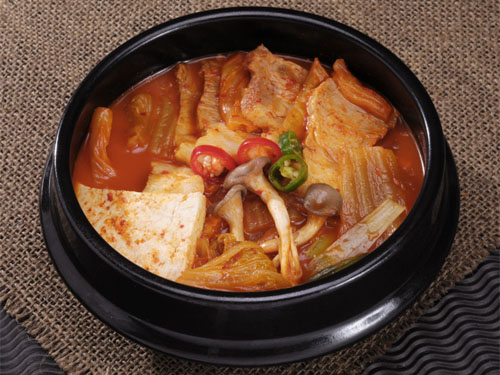
My favourite standard, without fail, dish is 김치찌개kim-chi-jigg-e. It's served as a spicy pot of soup filled with kimchi, pork and any other mix of ingredients like bean-sprouts, tofu, mushrooms. Its flavour comes from the kimchi, and the more there is, the tastier it is and the spicer it is. This dish is made even better (you have to find a good restaurant for this) by the abundant side dishes it's served with. Its perfection comes from it's simplicity and the satisfaction on any day of the year is unparalleld.

Im getting distracted and hungry. As varied as Korean food, is the enormous number of soup varieties; 미역국mi-yeok-guk / a kind of seaweed soup, 된장찌개dwen-jang-jiggae / a seafood soup with dwenjang as a base, 매운탕me-un-tang / spicy fish soup, often eaten after raw fash, 해장국he-jang-guk / an amazing hangover cure made with pig spine... The list goes on and on.
As you would expect from Korean there are many words for soup, the main ones being as above, 국guk, 찌개jji-ge, 탕tang and even the Konglish 슾seup / soup in a packet soup (I think it also goes for french style creamy soups). To the English native speaker, they all seem pretty similar (except for maybe 슾seup / soup in a packet soup (I think it also goes for french style creamy soups)). On the watery side with a very strong and spicy flavour. No mashing involved like in our soups, no milk, parsley or cream either. Yet for Koreans, these soups couldn't be more different. For the culinary explorer I have made the following short guide to Korean soup. (tomorrow)

Wednesday, 11 April 2012

The difference between 이제 and 지금

Now (지금jigeum) we are going to learn the difference between these two very similar words.

Before I continue, it's important to bear in mind that often these two words can be used interchangeably and only sometimes is just one of them approriate. Also a dictionary will not help you to understand these words, you need to look at them in context.

In these sentences, now means a specific point in time, and 지금jigeum can be translated alternatively as at the moment or at this point or presently or even this year, today, this month in order to show that we are in/at a period or time.

이제ij-ae on the other hand, shows that something has started (now) and it's effects will continue in to the future. That's a little bit complicated, so have a look below:

So here 이제ij-ae adds a dimension of something continuing from the present into the future, so a consistently good translation would be: from now

And there you have it. Now (이제ijae) you understand what they mean!