Saturday, 30 June 2012

Korean Basics: making a sentence

Maybe you can remember back to school days, or you’re an English teacher yourself? A sentence in English always needs at least 2 things, and normally more. But the two main things are:

  • a subject – they, she, it, the cat, a bird, my evil twinetc. etc.
  • a verb – eat(s) / swim(s) / run(s) / murdered etc. etc. (a doing word)

So “yes!” is not a sentence and “hungry” is not a sentence either, although you can kind of get what they mean. But what happens if you say “love”? Can you understand the meaning? Who do you love? Who loves you? Do you hate love? Is love great? can your evil twin love? It’s confusing, and it definitely is not a sentence.

In the last basics post I talked about verb endings and politeness. When we use them, it means that we are talking to someone. In English, it's the oppposite, our sentences show that someone is talking, that's why we always need a subject. Without a subject it's difficult to guess who is talking (see above).

Love in Korean is 사랑하다sarang-hada. This is the base form (remember) So when we put an ending on it means that there must be someone you're talking to because you are either showing, or not showing respect.
So imagine your mum is in front of you and you say 사랑해요sarang-hae-yo. In English this literally translates as "love" But of course, if your mum's in front of you, a better translation would be "I love you".

Korean, unlike English, does not need a subject, and often it does not need an object either (what comes after a verb, not before, like the "you" in "I love you"). You can work it out from the situation. So any verb with an ending on it, is in fact a sentence in Korean. So take any verb and put an ending on it! Congratulations! You're speaking Korean in full sentences

But of course sometimes you need to put these words in. Imagine there are three girls/boys in front of you. You want to tell one you love them. If you just say 사랑해요sarang-hae-yo they'll all think you love them!

Why Koreans translate so strangely

I met one of my friends after dinner once (in Korea), and he was visibly upset. He said “There was seaweed in my porridge!” you might think that this is a culinary travesty like jam in fried egg sandwiches, but this time it wasn’t. It was the result of mistranslation

What my friend had, had absolutely nothing to do with porridge. It was something closer to risotto called juk. Rice cooked a long time, served with savoury flavourings like kimchi or octopus or seaweed. But all Koreans call juk “porridge”. You actually see it written outside juk restaurants

The same goes with 찌개jjigg-ae. Much to the disappointment of new arrivals when they look at a menu, they see this translated as stew. Suddenly potatoes and tender meat in a thick sauce come to mind. You couldn’t be further from the truth. This is soup, plain and simple, albeit delicious.

Of course there are cultural reasons as to why all Koreans categorise these foods like this (I have to admit, I once saw 찌개jjig-ae called soup), but that’s for another time. This is pure conjecture, but I believe that these terms were coined pre-50s.

Porridge is not exactly a commonly eaten food, and to be honest, I am the only person who has such happy feelings when I think about stew. These are both foods of the past, which have been replaced by fancy things like "cereals" and "tagine".
I think that these words entered Korean when, either, the Americans occupied the South in the 1950s, or it could have taken place even earlier with the first missionaries. The Korean language has adopted these words so much that when you say (even in English) “찌개jjig-ae is not stew” no one believes you!

Korean doesnt just create Korean, and it doesn't just create Konglish, it even creates English. These odd translations remain to this day cemented in the Korean language, and will continue to confuse foreigners long into the future.

Sunday, 24 June 2012

국, 탕, 찌개, glorious soup!! - 탕 / tang

tang, not to to be confused with the Tang dynasty, is usually made with fish. It's most common incarnation is as 매운탕me-un-tang, a mixture of fish bones and heads from the hoe/(pronounced hw-eh) making process. It's sometimes free or costs just a little extra. It's name means spicy soup, so you have been warned. Also it can be a little awkward to eat because of all the fish bones. You've been warned a second time!
Like guk, tang is quite watery, but it contains many different ingredients, including moo / a massive mild radish and different kinds of spring-onions.

Wednesday, 20 June 2012

국, 탕, 찌개, glorious soup!! - 국 / guk

guk is probably the most common kind of soup. It generally has the highest ratio of water to ingredients. It's made from stock, which characterises this kind of soup. Generally it doesn't have many ingredients, either beef and some kind of cabbage - 소고기국(밥)so-go-gi-gukbap / beef soup and rice. Other varieties contain pretty much only noodles.

칼국수kal-guk-su is wheat noodles (a lot like homemade linguine) in broth. The taste is mild and it can contain clams, and other seafood depending on the variety. The noodles themselves are often homemade and make the soup soft and hearty.

잔치국수kal-guk-su is a must have. It's simple and filling and most importantly cheap. Even the most hardened Korean-food hating westerner can't dislike this. It's basically spaghetti like noodles in fish stock or broth (often you can't even tell that it's made from fish)You add your own flavouring, generally a few spring onions in soy sauce. At 2000won a hit, you cant go wrong. Also, in the summer it's served at room temperature, so the only sweating you'll be doing is from eating it too fast!

국, 탕, 찌개, glorious soup!! - 된장찌개 - dwenjang-jjig-e

찌개jji-ge, mis-translated by Koreans as stew (much to the dissapointment of the international community, and something which I will discuss in the next post), is similar to tangin terms of quantity of ingredients. What makes it different is that the flavour comes, not from meat, fish, or stock, but fermented produce, either 김치kimchi or 됀장dwen-jang. Both these ingredients can be quite strong, so what turns out is a surprisingly rich and hearty, yet still very liquidy soup.
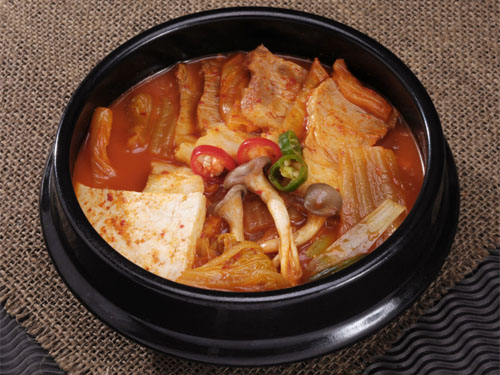
된장찌개dwen-jang-jigg-e normally contains clams or shrimps. Just like 김치찌개kim-chi-jigg-ae it also can contain tofu, chillis, spring onions etc. Like tang a good 찌개jji-ge should have many more ingredients than liquid. If it doesn't, the restaurant is skimping on costs.

국, 탕, 찌개, glorious soup!! - Kimchi-jigge

Food is ubiquitous in Korea and its variety, quality and uniqueness put it on a par with any of the other great culinary nations. Food is one of the main reasons why I came to Korea in the first place and if you take into consideration that it's a small, cold country, Korean food is even more impressive. (Compare it to the small, cold country I come from, for example).

My favourite standard, without fail, dish is 김치찌개kim-chi-jigg-e. It's served as a spicy pot of soup filled with kimchi, pork and any other mix of ingredients like bean-sprouts, tofu, mushrooms. Its flavour comes from the kimchi, and the more there is, the tastier it is and the spicer it is. This dish is made even better (you have to find a good restaurant for this) by the abundant side dishes it's served with. Its perfection comes from it's simplicity and the satisfaction on any day of the year is unparalleld.

Im getting distracted and hungry. As varied as Korean food, is the enormous number of soup varieties; 미역국mi-yeok-guk / a kind of seaweed soup, 된장찌개dwen-jang-jiggae / a seafood soup with dwenjang as a base, 매운탕me-un-tang / spicy fish soup, often eaten after raw fash, 해장국he-jang-guk / an amazing hangover cure made with pig spine... The list goes on and on.
As you would expect from Korean there are many words for soup, the main ones being as above, guk, 찌개jji-ge, tang and even the Konglish seup / soup in a packet soup (I think it also goes for french style creamy soups). To the English native speaker, they all seem pretty similar (except for maybe seup / soup in a packet soup (I think it also goes for french style creamy soups)). On the watery side with a very strong and spicy flavour. No mashing involved like in our soups, no milk, parsley or cream either. Yet for Koreans, these soups couldn't be more different. For the culinary explorer I have made the following short guide to Korean soup. (tomorrow)

Basics: Speech levels and politeness 3 -입니다 / immida

In the last post we saw how -요-yo is used to show that you are lower on the scale of life than the person you are talking to. Which means that even when used improperly, it can't be offensive, but it can be funny.

Today we are going to look at the formal -입니다-immi-da.
Remember who this is used for? generally it's people you don't want to or don't have a personal relationship with. That's bosses, colleagues, people in banks, clients, or even strangers (depending on you and your personality).

BasicallyThis is the very basic rule, verbs actually change a little
depending on the stem, but here these are just examples.
If you want the exact rules go to the links section
, to form it you drop the -다-da from the base form and add -입니다-immi-da

It is said that boys use this ending more than girls and girls use -요-yo more than boys. This is because (don't start raging please feminists) girls are lower on the scale than boys. So when boys of the same age meet in a formal context, they don't need to say "im lower than you" and girls are more inclined to. As a male, I kind of understand this. I don't want to be cute and friendly to everyone. If I want to get things done, I get them done, I don't need to be your friend.

In everyday speech you encounter this in introductions, because you don't know the people you're speaking to, and often you don't need to endear yourself to them either. But if you do establish a relationship, then you no longer need to use this ending. If you do continue using it, it can mean that you don't feel close to the person you're talking to.