Wednesday, 20 June 2012

국, 탕, 찌개, glorious soup!! - Kimchi-jigge

Food is ubiquitous in Korea and its variety, quality and uniqueness put it on a par with any of the other great culinary nations. Food is one of the main reasons why I came to Korea in the first place and if you take into consideration that it's a small, cold country, Korean food is even more impressive. (Compare it to the small, cold country I come from, for example).
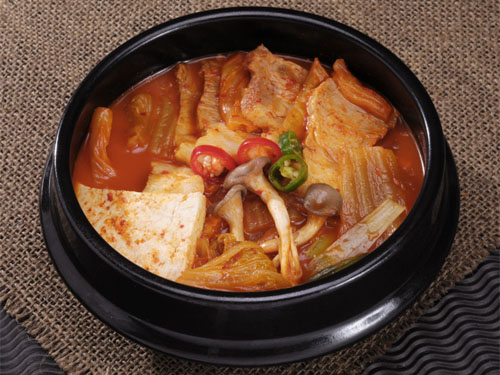
My favourite standard, without fail, dish is 김치찌개kim-chi-jigg-e. It's served as a spicy pot of soup filled with kimchi, pork and any other mix of ingredients like bean-sprouts, tofu, mushrooms. Its flavour comes from the kimchi, and the more there is, the tastier it is and the spicer it is. This dish is made even better (you have to find a good restaurant for this) by the abundant side dishes it's served with. Its perfection comes from it's simplicity and the satisfaction on any day of the year is unparalleld.

Im getting distracted and hungry. As varied as Korean food, is the enormous number of soup varieties; 미역국mi-yeok-guk / a kind of seaweed soup, 된장찌개dwen-jang-jiggae / a seafood soup with dwenjang as a base, 매운탕me-un-tang / spicy fish soup, often eaten after raw fash, 해장국he-jang-guk / an amazing hangover cure made with pig spine... The list goes on and on.
As you would expect from Korean there are many words for soup, the main ones being as above, 국guk, 찌개jji-ge, 탕tang and even the Konglish 슾seup / soup in a packet soup (I think it also goes for french style creamy soups). To the English native speaker, they all seem pretty similar (except for maybe 슾seup / soup in a packet soup (I think it also goes for french style creamy soups)). On the watery side with a very strong and spicy flavour. No mashing involved like in our soups, no milk, parsley or cream either. Yet for Koreans, these soups couldn't be more different. For the culinary explorer I have made the following short guide to Korean soup. (tomorrow)

Basics: Speech levels and politeness 3 -입니다 / immida

In the last post we saw how -요-yo is used to show that you are lower on the scale of life than the person you are talking to. Which means that even when used improperly, it can't be offensive, but it can be funny.

Today we are going to look at the formal -입니다-immi-da.
Remember who this is used for? generally it's people you don't want to or don't have a personal relationship with. That's bosses, colleagues, people in banks, clients, or even strangers (depending on you and your personality).

BasicallyThis is the very basic rule, verbs actually change a little
depending on the stem, but here these are just examples.
If you want the exact rules go to the links section
, to form it you drop the -다-da from the base form and add -입니다-immi-da

It is said that boys use this ending more than girls and girls use -요-yo more than boys. This is because (don't start raging please feminists) girls are lower on the scale than boys. So when boys of the same age meet in a formal context, they don't need to say "im lower than you" and girls are more inclined to. As a male, I kind of understand this. I don't want to be cute and friendly to everyone. If I want to get things done, I get them done, I don't need to be your friend.

In everyday speech you encounter this in introductions, because you don't know the people you're speaking to, and often you don't need to endear yourself to them either. But if you do establish a relationship, then you no longer need to use this ending. If you do continue using it, it can mean that you don't feel close to the person you're talking to.

Tuesday, 19 June 2012

Speech levels and politeness 4: 아/어 -a/-eo - close friends and children

So far we've seen to very different endings. One which shows that you respect the person you're talking to, and one which shows that even you respect them, you don't have any personal interest in them. This final ending is used mainly with the familiar

Familiar Means people you know very well and people who are a lot younger than you. That means if you're in your 20s, 30s, 40s and perhaps even 50s it basically means kids only. If you're a Korean it includes foreigners and if you're in your 50s+ it means whippersnappers.
Basically you take off the -다-da and add the -아 or -어-a or -eo.

Unlike -요-yo this ending can be offensive, because you are saying to someone "you are lower than me" as opposed to "I am lower than you". That's why they generally don't teach this at the beginning of courses.

It will be used a lot to you, but don't use it back, and dont be offended. Koreans are being nice when they use it to you. For some reason they think that other endings are harder for foreigners to understand.
The only time you use it should be with children. Koreans often use it with extremely close friends (people the have known for years), family and lovers. So I suppose if you get lucky, go right ahead.

These are the three endings which you will have most contact with. If you come to Korea, you will hear others, but once you've mastered these the other ones will follow logically. Even for a foreigner these are easy to understand, it's using them that it's difficult!

Saturday, 16 June 2012

Basics: Speech levels and politeness 2: 요 or -yo

In the last post we saw some different people you might talk to, and the terms formal, informal, familiar. Remember who we might use them with?
Today, we're going to look at the actual endings

The most general ending which foreigners use is -요-yo. This is generally used in informal and familiar situations. So you would use it with your friends, family and when chatting to strangers.
Remember the base form of verbs? BasicallyThis is the very basic rule, verbs actually change a little
depending on the stem, but here these are just examples.
If you want the exact rules go to the links section
Just drop the -다-da depending on the verb add -아-/-어--a-/-eo- and then the -요-yo.

This ending is generally taught as the default ending to students, because it cant be offensive to anyone. But with children, it is inappropriate. Why? well that's because with this ending, you are putting yourself lower than the person you're speaking to.
On the Korean scale of life, children are lower. Imagine being the king and bowing to a random kid who walks into your castle? It's pretty much the same thing when you use -요-yo with a child.

But when you use it with a stranger or someone the same age, and they use it back you are both on the same level because essentially you're bowing to each otehr. Imagine a disgusting lovey-dovey couple saying "I love you" / "no I love you more" back and forth to each other. When you use -요-yo you're saying "I respect you" / "no, I respect you" back and forth to each other. The point being in the first sentence "my love is equal" and the second example "our respect is equal".

Korean basics: verbs 2 / Speech levels & politeness 1

So there are two kinds of verbs, descriptive and normal. In their usual forms they are identical. They both take tense endings and politeness endings. Which is what we will look at today.

Speech levels or politeness endings are very important in Korean, and can be very confusing. But the first rule of communication is "don't panic" (that should be the first rule about pretty much anything new). But actually, If you think about it, you do actually change the way you speak depending on you talk to, even in English.
You don't say "alright mate"US English "waddup my beeee-atch to your boss do you? It might be strange to say it to someone you've just met too. But it would be ok to say it to your friend. You probably wouldn't say it to your Dad, and you're pretty weird if you say it to your Grandad. And what if you said it a five year old?

Korean has exactly the same situations, but instead of only using different words or intonation, accent, etc, Korean always puts an ending on the verb. looking back at the different people you would/wouldn't say "alright mate" to we have:

Generally the words formal, informal, and familiar are used to describe the endings, Which of the situations above fall into those categories?

That's right! Formal is for situations where there is not yet a personal relationship. Maybe one will develop, but maybe it would be inappropriate, ie with your boss. So logically you would add a formal ending in that situation.

Familiar is where you do have a personal relationship with someone. So that's your friends and family

Well what about informal? That's when things get complicated, because in English there's one thing that we don't really take into account. And that's..... age! Informal applies to situations when you speak to someone who is the same age or younger, but you don't know them well. You're not going to discuss taxes and politics with a child are you?

Tuesday, 5 June 2012

Korean basics 1: verbs

Every single book about Korean that I have seen so far starts off with the awfully confusing and painfully wrong statement that Korean word order is BLAH BLAH BLAH.
I am not going to do the same thing. So I will come back to word order another time.

Perhaps the biggest difference between Korean and European languages is the way verbs work. In Korean there are 2 distinct kinds of verbs, verbs and descriptive verbs.

Verbs function a lot like (but not exactly like) verbs in European languages. They take a variety of endings and/or particles and generally (not always) describe things that you do or states you are in.

Descriptive Verbs do not exist in European languages. Descriptive verbs describe the nature of something, but they are still verbs. Koreans and most language learners WRONGLY use the term “adjective” to describe them. These are not adjectives!!! THERE ARE NO ADJECTIVES IN KOREAN. If you see them as adjectives, you WILL NEVER LEARN KOREAN PROPERLY. Why do you think Koreans find adjectives in English so difficult? Because they see them as verbs, that’s why they always leave off “is/are” etc. For a Korean “to eat” and “to be hungry” are in the same grammatical category and therefore don’t need a verb (to be).

Got it? One more time. There are no adjectives in Korean.

All verbs have a very simple base form. This base form is used in dictionaries and in the plain style. Basically it's the verb plus -다-da. So in a dictionary you would find 예쁘다ye-ppeu-da / to be pretty - yes this is a descriptive verb or 먹다meog-da / to eat - this is a normal verb

Fundamentally different to European languages are the verb endings. Where most European verbs change to indicate who is speaking, Korean verbs change the most depending on who you are speaking to.

So there are four things to remember while you learn Korean:

  • There are two kinds of verbs
  • Verbs are about who you are talking to, not who is talking
  • There are no adjectives in Korean
  • verbs have a base form, ending in -다-da which is mainly used in dictionaries

Thinking about Thinking day 3

Much like the first post about the verb 생각 하다/나다seng-gak hada/nada / think... etc. where we saw you can put any noun in front of 생각 하다/나다seng-gak hada/nada / think... to mean you are thinking about something. Here we are going to see how to say think about doing something.

It's actually much simpler than saying "I think that..." (thinking about thinking day 2) because the time is always about the future or present. You can't say I'm thinking about went to the shop! Also it can only be used with normal verbs, not descriptive verbs. You can't say I'm thinking about smelly!

As I said it's relatively straightforward. You take a verb, say 공부 하다gong-bu hada / study. You drop the -다-da add -는-neun and then the noun 것geot. 것geot actually means "thing". So what this means, roughly-literally, is "the studying thing" or "the thing which is studying".
Have a look at these examples:

One thing to think about is, how often do Koreans actually say this? Not very often is the answer. As you may have noticed other verbs also mean think, and there are countless ways of impying opinion through particles and endings. Either way though, these forms will be very helpful to an English native speaker!